


The Gauntlet has obtained presentation slides from Alberta’s Ministry of Advanced Education showing a proposed new tuition framework for Alberta’s post-secondary students.
The slides obtained by the Gauntlet come from a presentation from the ministry to student leaders across the province in late August.
The proposed tuition framework presented to student leaders follows the recommendations from the 2025 “Expert Panel on Post-Secondary Institution Funding and Alberta’s Competitiveness,” known commonly as the Mintz Panel Report.
The Mintz Panel Report examined similar funding frameworks from Australia, New Zealand and the United Kingdom.
In Australia, a similar funding model introduced by the Morrison government saw a significant increase in fees to arts and creative courses, with a study completed in 2026 by the Australian Journal of Education seeing a decrease in students studying in arts courses, as reported by the Guardian.
“The Alberta government seems to want to import an already failed model out of Australia. We have made it clear to the Ministry of Advanced Education that we strongly oppose this model. As proposed, this new model would inject chaos into young Albertans’ education and worsen the affordability crisis we’re already suffering,” said SU President Gabriela Dziegielewska in a statement to the Gauntlet.
The policy has been met with significant backlash in Australia, with calls for a reversal from the current Albanese government.
“My mandate letter directs me to review the findings and recommendations of Alberta's Expert Panel on Post-Secondary Institution Funding and Alberta's Competitiveness. Information will be provided when decisions are made,” said Myles McDougall, Alberta’s Minister of Advanced Education in a statement to the Gauntlet.
The proposal presented to student leaders included an enrolment-driven component, a performance-driven component and a base funding component, matching the recommendation from the Mintz Panel’s report.
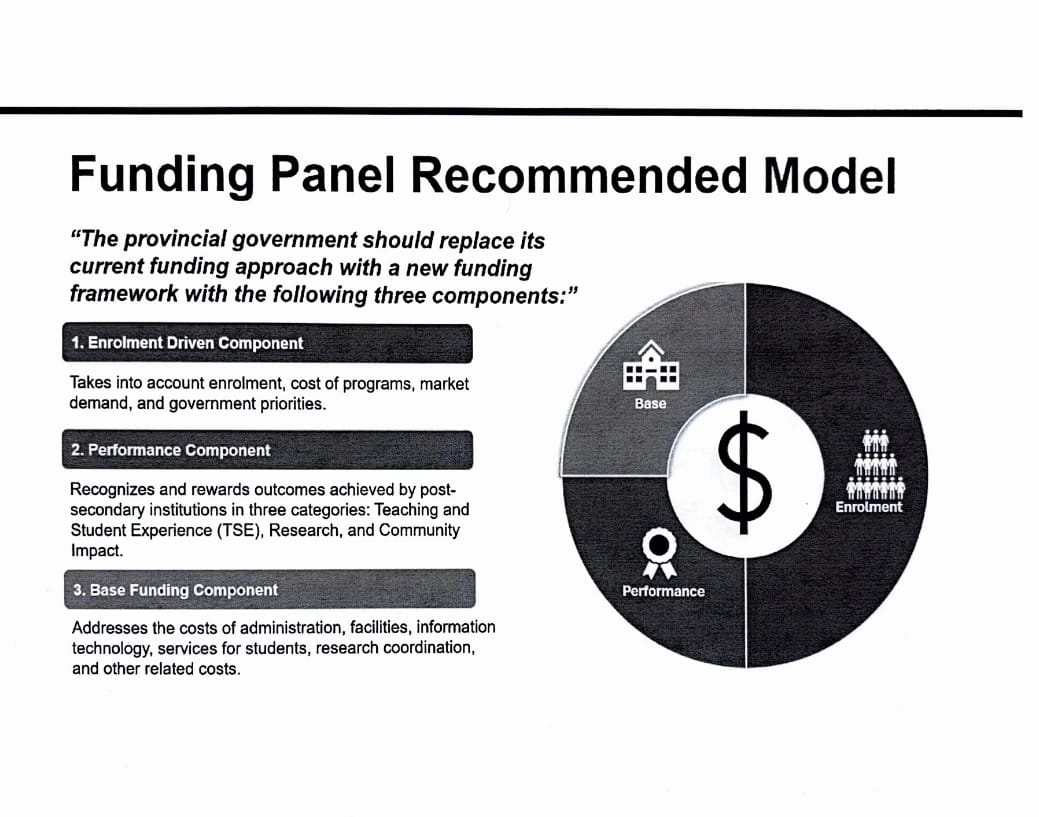
The enrolment-driven component “takes into account enrolment, cost of programs, market demand, and government priorities” while the performance component “recognizes and rewards outcomes achieved by post-secondary institutions in three categories: Teaching and Student Experience (TSE), research, and Community Impact.” The base funding component “addresses the costs of administration, facilities, information technology, research coordination, and other related costs.”
In the documents as recommended in the report, post-secondary programs are placed in “clusters” with the government and students paying more or less depending on which cluster the program is placed.
“Cluster 1” includes those of “high government priority and high labour market-alignment” while “Cluster 5” encompasses “low government priority and low labour market-alignment.”
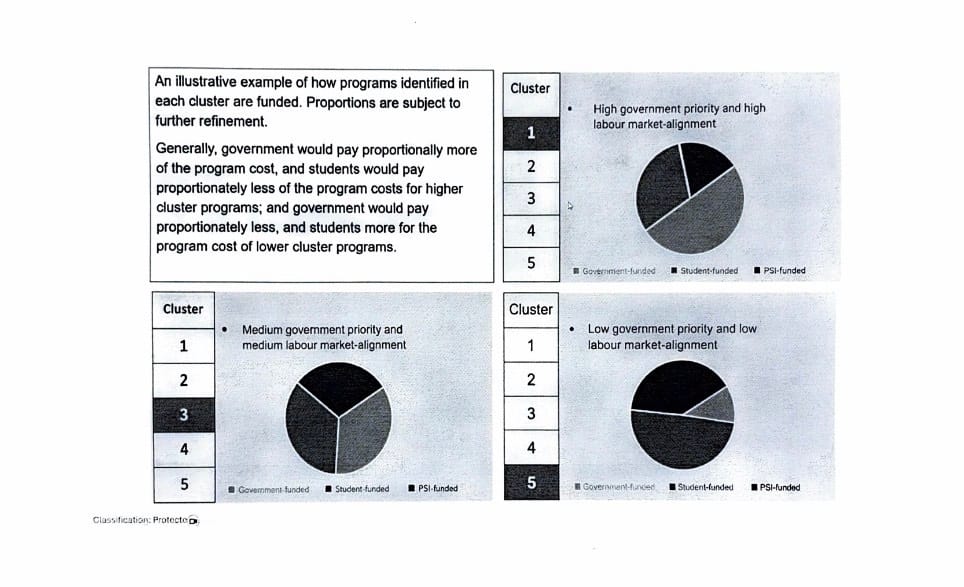
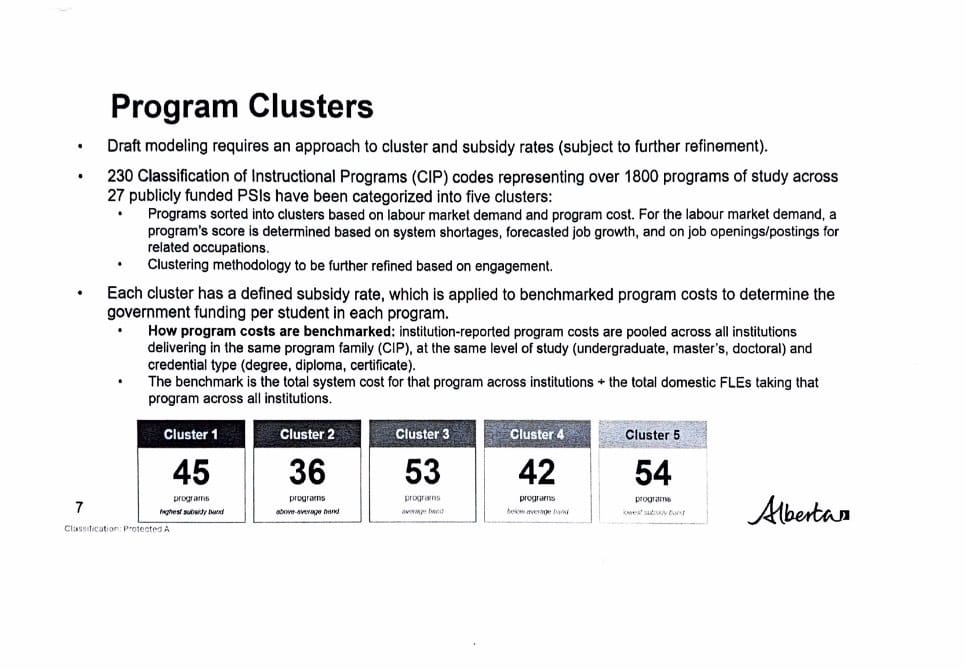
It remains unclear from the slides what programs will be placed in which of the five clusters. 45 post-secondary programs are currently planned to be placed in cluster one (the highest subsidy band) while 54 post-secondary programs will be placed in cluster five (the lowest subsidy ban).
The ministry is “developing a tuition framework that moves from regulating tuition growth to tuition maximums set by the Minister” stating that this approach “will better standardize tuition levels for programs using the same ‘CIP’ (classification of instructional program) codes”
Post-secondary programs are sorted into the five clusters based on labour market demand and program cost.
“For the labour market demand, a program's score is determined based on system shortages, forecasted job growth, and on job openings/postings for related occupations,” the slides state.
The clusters would have a defined subsidy rate to determine a rate of funding per student in each program, according to the slides.
“The University of Calgary is in regular and continuous discussion with the Ministry of Advanced Education on a number of topics. We don’t have anything specific to share at this time,” said the University of Calgary in a statement to the Gauntlet.
Notably, the Mintz panel recommended that the new funding framework be phased over the next five years.
While the final proposed tuition framework is yet to be made public, slides obtained show that the ministry hopes to begin the transition in the 2027/28 academic year, and provides further insight on the government’s thinking of the Mintz panel recommendation.


