
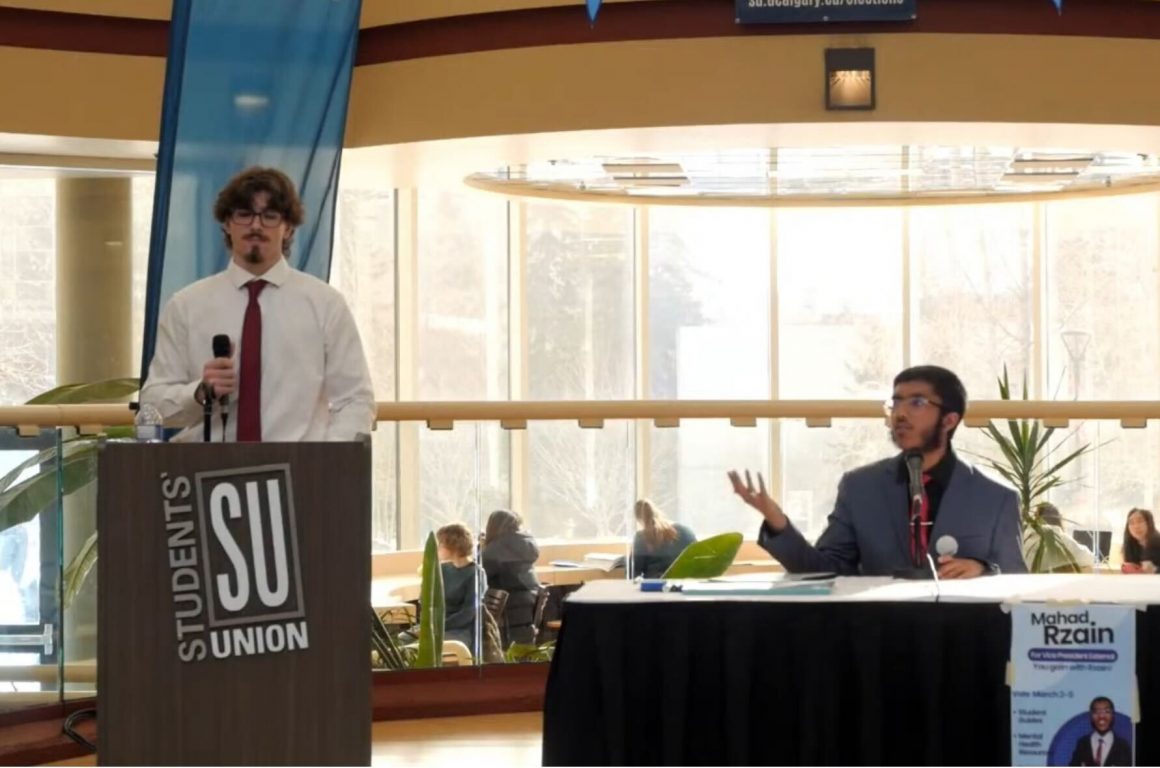
Mahad Rzain outlines his plan for stable tuition, employment and housing support and mental health advocacy at SU election forum
By Danijela Marcinkovic, March 4 2026—
At the SU General Election forums, uncontested, VIce President External candidate Mahad Rzain discussed his plans to reduce costs for students and promote student wellbeing.
Rzain noted that it is difficult to secure housing and employment as a student, and mentioned ways he seeks to combat that.
“I want to push for resources to…inform students more about employment opportunities,” Rzain stated. “I intend to create a housing and employment guide. I intend to advocate to the municipal level for city level employment resources.”
When asked what recommendation from the Expert Panel on Post Secondary Funding and Alberta’s Competitiveness Rzain would pursue first, he said that he believes the SU should first pursue a stable tuition for students.
“Students once granted admission…ought to be provided with a…guaranteed tuition that will not fluctuate throughout their degree,” Rzain stated. “If [the] university chooses to adjust tuition increases, that would be for new incoming students. Current students would enjoy stable and predictable tuition as a result.”
When asked how he will remain non-partisan during his term, Rzain stated that focussing on issues at hand is what is key.
“At the end of the day, we are supporting the solutions to these issues,” he stated. “We are supporting the solutions to affordability, to implementing the Mintz Panel recommendations…therefore, one needs to be open to negotiate and involve all relevant stakeholders, regardless of their affiliation.”
Rzain agrees that mental health is a prevalent issue for students, and has a point on his platform dedicated to mental health.
“One thing I intend is not only to increase funding for the University’s supports, but…promoting awareness for those university supports, providing more opportunities for students to know about what exists on campus, how [they can] get a referral to health specialists, et cetera,” he said. “I want to extend this fight beyond the university and to also mobilize and receive input from students.”
“Ultimately I envision myself working with…various groups, CSA, CASA, but of course, in the university advocating for more access to mental health resources, and access to information,” he said.
When asked how he will address the issue of international student enrolments declining, Rzain stated that the focus is advocating for affordable housing and employment.
“I view working within federal lobbying, working with groups such as CASA in order to advocate for more resources for student employment and advocate for students to become aware of…opportunities,” he stated. “The key is to use these…decreasing international student admissions as evidence, and this becomes stronger…for our lobbying efforts and to push the federal government to invest more in housing and even play a role in employment.”
Rzain was asked which of the SU’s main advocacy issues in the past two years most interests him and one where he would have done things differently.
“One of the most intriguing aspects…has been within tuition. Particularly on the protection and preservation of the Canada Student Grants,” he said. “I really admire the work…that the Vice President External and…the Student’s Union have been able to…[increase] that grant number to about 4,200.”
Rzain stated that this grant number is set to decrease to the 2016 level of $3000, and wants to prevent this.
“I am very interested to…preserve [the current grant level] but to increase the grants further,” he said.
One thing Rzain said he would do differently is within the Canada Student Grant deal described.
“It’s a very temporary deal,” he said. “What I would have done differently is set…a more firm deal.”
Rzain was asked what the SU should be doing while we wait for student housing to be built downtown, as the City of Calgary allocated $25 million for this two years ago.
Rzain answered by stating that he will advocate for students to be informed about housing opportunities, and mentioned the housing and employment guide he intends to create.
The rising cost of tuition is the biggest issue for students right now, and many stakeholders are involved in this issue. These being the Tuitions and Fees Committee, the University Admin and Board, the Student’s Legislative Council and the Provincial Government. Rzain discussed how he will approach these groups as well as how he would communicate his efforts with the student body.
“Ultimately what we want to do is lobby and work on…implementing the recommendations of the Mintz report…increasing provincial funding in post-secondary education, looking at…producing zero interest provincial student loans and looking at different…avenues…that alleviate and support students,” he said.
In terms of communicating with students, his aim is to get them involved.
“It is critical that we meet students where they’re at, whether that be town halls,…social media materials…and informing them about key issues,” he said.
Rzain discusses creating a guide to getting involved in politics for students and what it will entail.
“Step one…[is] informing students about their representatives in a clear and distinct way…really just trying to clarify to students who is serving what ward, what riding, who their representatives are and their contact information,” he said. “Having one guide will offer students a focussed way to…know who their representatives are [and] how to interact with them.”
“Next, it’ll…inform them at a high level about…key issues within each level of government…and other ways you can get involved, whether it be through lobbying,…joining various organizations and…how they can get involved in Student’s Union,” he said.
Rzain also discussed what his housing and employment guide will entail.
“One thing that I want this guide to focus on is…providing different ways one can attain employment…high level tips, basic resume tips, career tips,” he said. “The reason I put [housing and employment] in the same guide is because…once students are able to attain a vast amount of income, they’re able to [afford] housing and then they can consult places…for students.”
“I view my guides…as a meta analysis, providing links and giving access to that information about the resources that give access to housing,” he said.
“I want to work with the students. I don’t view myself as above the students in any way. We are a team, and if I don’t know what they want, I can’t advocate for what they want,” Rzain stated. “It’s very critical to get the students involved.”
Voting for the 2026 SU General Election and the Mac Hall referendum takes place online from March 3 to 5 through the myUofC Student Centre. In-person polling stations in Information and Communications Technology (ICT), MacEwan Student Centre and the TFDL foyer will be available from 10 a.m. to 4 p.m. on voting days. All UofC undergraduates registered in the Winter 2026 term are eligible to vote.