
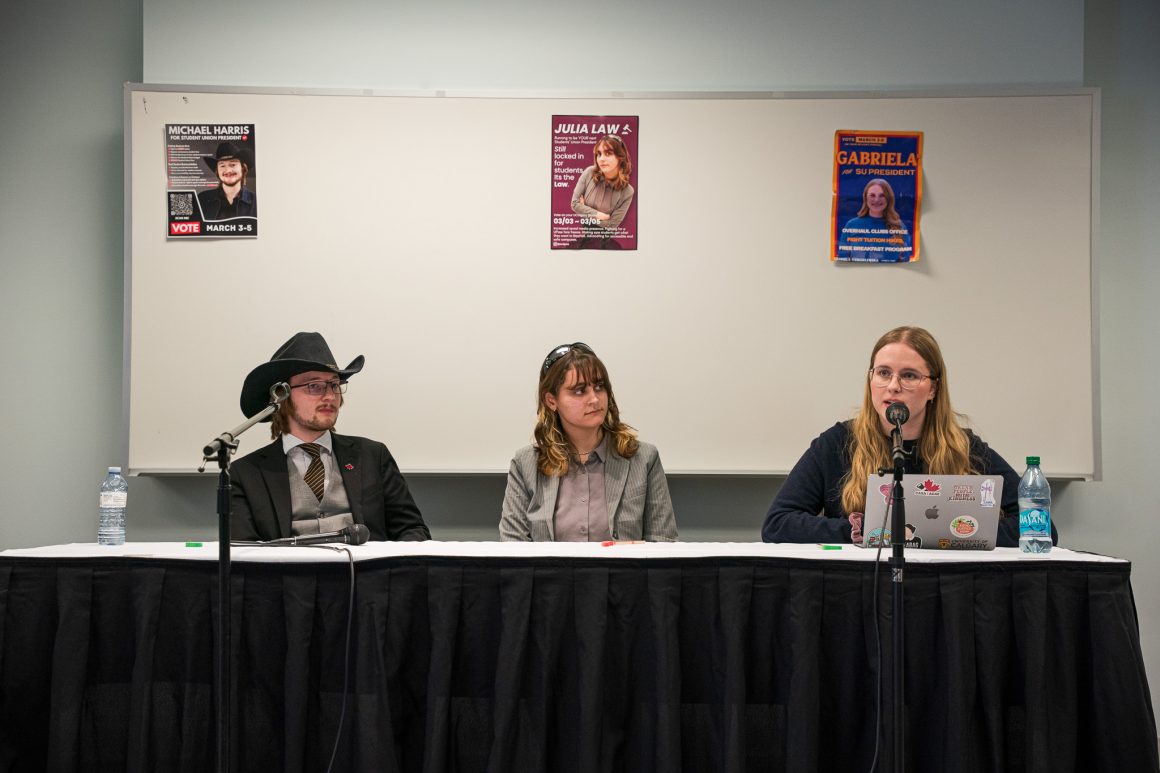
Transparency takes focus at 2026 Gauntlet SU presidential debate
By Alexander Howey, March 5 2026—
On Feb. 24, the Gauntlet hosted the Students’ Union (SU) presidential debate, where 48 students gathered to assess the three candidates running for the presidential position.
Third-year political science student Michael Harris opened by discussing the importance of transparency in student governance.
“I have seen for the last three and a half years career politicians running the student union to bring policies that they could never possibly hope to accomplish,” Harris explained.
“I will fight for you to protect your freedom of speech, protect your liberty, to protect transparency and to make sure that we have an affordable campus for all,” he concluded.
The next candidate introduced was current VP External Julia Law.
“I know the ropes, I know what’s going wrong and I know how to fix it,” she said.
“You also need to know what’s going on at your SU. You might find that you only hear about what’s going on with issues too late-stage,” Law explained.
“It’s time for you to know what’s going on soon rather than later.”
The final candidate was current VP Academic Gabriela Dziegielewska.
“As VP Academic, I’ve secured a review of advising offices, I’ve launched a successful campus wide campaign about your academic rights and I’ve hunted down policy violations that resulted in your education being more expensive.”
“While my opponents believe in playing nice with the university and the province, I do not. I’m running to restore a sense of fight back to the SU and I hope I can earn your vote,” she concluded.
“Students deserve to know what’s going on sooner rather than later so that they can mobilize and that they can have a say,” Law answered when asked what the SU could do better going forward.
“We need to be communicating to students on progress and on results,” Dziegielewska added.
Dziegielewska also elaborated on what an “aggressive” campaign means: “There’s a lot of avenues that the SU can use to actually fight for things.”
“It means drumming up media pressure to make sure that it’s not just students on this campus that care and that are invested in these issues,” she added, talking about the importance of mobilizing the general public.
Dziegielewska also discussed the importance of students’ right to protest.
“I think the SU’s job is to make sure that we are defending students on this campus,” Dziegielewska explained.
“That means using the media, that means lobbying, but it also means using our considerable budget to look at legal injunctions, to look at getting lawyers to defend students if that’s how bad it gets.”
When asked how she planned to freeze the U-Pass fare, Law responded:
“I think it first starts with the SU being privy to the agreement that the university makes with Calgary Transit for the U-Pass,” she said. “And that also means showing up to budget deliberations. It means lobbying city councillors.”
Harris discussed salaries for SU executives, pledging to forgo a wage if elected.
“My main issue is that people come in for one term, whether it be a president or executive, and they collect a big paycheck. We don’t even know how much they get paid because they keep increasing it and I would like to first of all make that transparent.”
However, there is an annual public record of SU fees and finances at https://su.ucalgary.ca/about/more/financial/.
The candidates then discussed the upcoming arts renewals program suspensions.
“[The Faculty of Arts] is subsidizing the rest of the campus and they’re bleeding while other faculties are doing fine,” Dziegielewska explained.
“There is interest from faculties on this campus to rebalance the tuition split and that will directly benefit arts.”
“Most art students were unaware of the changes until the CBC investigative article came out last week,” Julia added.
The candidates also discussed the elimination of the Quality Money Fund:
“The ideal outcome is keeping quality money within the student’s union control,” said Dziegielewska, emphasizing the importance of mobilizing students and clubs.
“It’s about mobilizing and showing these are the things on campus that would disappear if you didn’t have quality money,” Julia added.
The candidates additionally discussed what they would advocate for in the MacEwan Hall expansion.
“We’ve seen that the priorities for students is more study space, more hangout space, and more food options on campus,” Dziegielewska explained.
“Fundamentally, this expansion is going to and foremost for serving students, for serving them with the spaces that they need.”
“I think it looks like ongoing consultation in the forms of focus groups, informal consultation, and regular questions on the SU’s annual survey to stay informed with what the students want,” Law added.
Harris discussed his opposition towards the MacEwan Hall referendum.
“I’ve seen many referendums like this over the last three and a half years,” he said. “They increase your student union fees and usually they just sit on the money or use it for other projects.”
On the topic of Dziegielewska’s goal of restoring the SU Breakfast Program, Law stated: “What is unclear about this is what programs and services are going to be cut in lieu of bringing forward the breakfast program.”
Dziegielewska elaborated that what would be cut isn’t predetermined, and will work with the director of student services
“I think we need to support the students’ fundamental basic needs and food and security is one of those things,” she argued.
When asked what leverage she would use to advocate against student loan grants being cut to 2016 levels, Law elaborated:
“The Canadian Alliance of Students Association currently has a petition out to the House of Commons which you can sign.”
The candidates each then offered closing statements.
“I am prepared to get work done by working 40 hours a week if that’s what it takes,” Harris said. “I wish to make sure that our union can stay independent, fair and transparent.”
“I was one of two students who was fighting tuition increases, got that international student cap down to 5 per cent down from 10.” Law explained. ““I’ve been doing the work for the last year, and it’s time that I continue the work.”
Dziegielewska closed by saying if elected, “You can expect an SU that will mobilize 30,000 undergraduates to be a major political force in this province. And you can expect an SU that will fight to ensure that your student experience gets better from things like major policy wins to small everyday things like service improvements.”
Voting will take place from March 3 to 5 online through the My UCalgary student page, and in-person from 10:00am to 4:00pm.
Polling stations will be located in the TFDL foyer, MacEwan Student Centre, and Information and Communications Technology (ICT).
All of the candidates’ platforms can all be read at: https://su.ucalgary.ca/about/elections/candidates-ge2026/.