
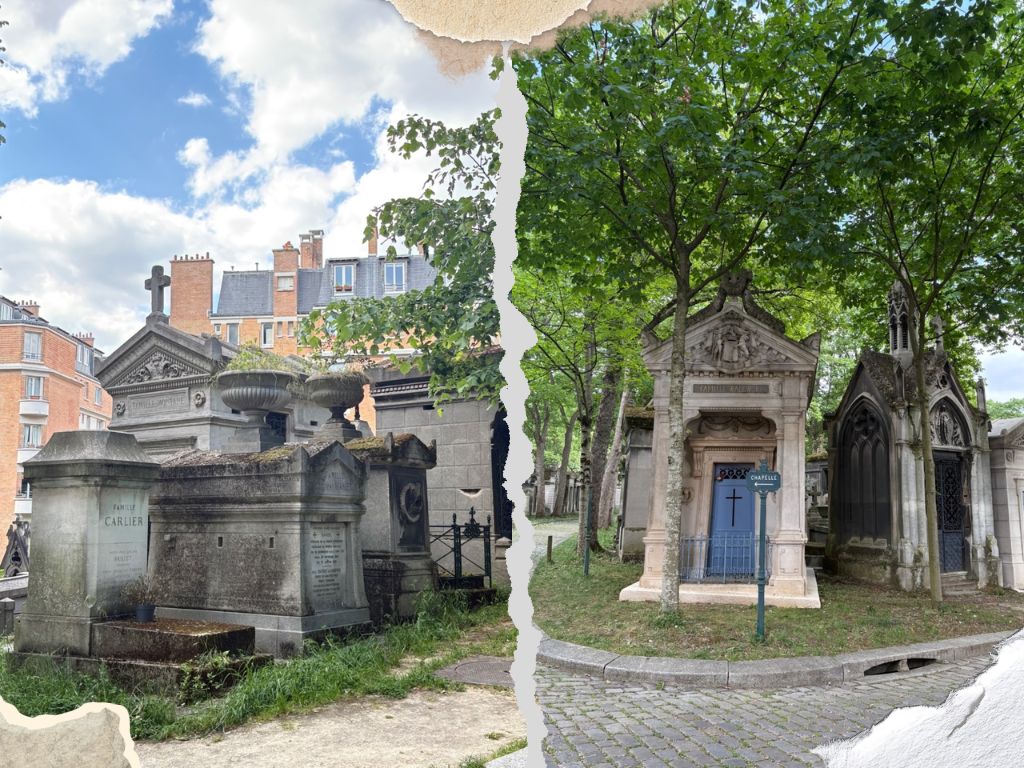
A public space for the dead — and a mirror of the living: Class difference in Pere-Lachaise cemetery
By Garima Chahal, April 24 2026—
I visited Père-Lachaise Cemetery last year as part of a research project examining sustainability and livability in European cities. Our task was deceptively simple: to understand why Père-Lachaise is considered a public space, and how it functions as one.
At first glance, the answer seems obvious. The gates are open. People walk freely. Tourists, locals, mourners, joggers, couples and students coexist in the same space. It operates like a park with its quiet paths, benches, trees and moments of pause.
But the longer I spent there, the more I realized that Père-Lachaise is not just a public space in the conventional sense. It is a social archive, one that reveals who is allowed to occupy space and for how long, even after death.
As a public space, the cemetery is shared, but as a social space, it is deeply unequal.
Some graves are enormous — entire family tombs are sealed behind iron gates, designed to house generations together, yet apart from everyone else. These tombs resemble private homes for the dead, asserting permanence and lineage. They tell stories of families who could afford not just burial, but continuity.
Nearby, solitary graves sit quietly: one name, one body and no indication that anyone will ever join them. Even in death, some people are surrounded. Others remain alone.
That contrast feels deeply poetic, but also deeply political.
Public space is often framed as democratic — accessible to all, owned by no one. Yet Père-Lachaise shows how class operates within public spaces. Burial plots vary in size, cost and duration. Some are permanent, while others are leased, meaning that if no one remains to renew them, the dead are relocated and their markers removed. In this way, even death is governed by contracts, affordability and property relations.
From a Marxist perspective, this is not surprising. Karl Marx argued that material conditions structure social life, and Père-Lachaise reveals that they also structure social death. Space, memory and permanence are distributed unevenly, even in a place meant for collective rest.
Walking deeper into the cemetery, I noticed another pattern: maintenance. The graves of those who had died recently were clean, maintained and surrounded by flowers and notes. Someone still came back. Someone still remembered. In contrast, other graves were cracked, moss-covered and nearly illegible — not necessarily because they were old, but because there was no one left to care for them.
There is something haunting about that. It makes you think about life and death differently — about how people do not truly die when their heart stops, but when their name is spoken for the last time.
Yet some graves resist being forgotten entirely.
The graves of Oscar Wilde, Édith Piaf and Jim Morrison are meticulously maintained, despite the fact that they died ages ago. Wilde’s grave, over 120 years old, is still visited daily, complete with flowers, letters, barriers and security. People who never knew him mourn him anyway.
In this sense, Père-Lachaise functions as a public space of memory. Cultural achievement becomes a form of permanence. Fame acts as capital, ensuring preservation long after biological life ends. Those who “achieve great things” are allowed to live forever — not biologically, but socially.
This raises an uncomfortable question: If public space is meant to be shared equally, why is remembrance so unevenly distributed?
Sustainability is often discussed in terms of infrastructure, green space or long-term urban planning. Père-Lachaise complicates that conversation. It shows that sustainability is also about social continuity: who is remembered, who is erased and whose presence is allowed to endure. A livable city is not just one that supports the living, but one that acknowledges the dead — without turning memory into a privilege.
Père-Lachaise does not merely accommodate death. It curates it. It preserves some lives in stone while allowing others to fade quietly into the landscape. As a public space, it invites everyone in. As a social space, it reveals how deeply inequality is embedded in even our most universal experiences.
Leaving the cemetery, I realized that our research question had shifted. Père-Lachaise is a public space not because it is open, but because it reflects society back to itself — its values, its hierarchies and its fears.
Death may be universal. Remembrance is not.
This article is a part of our Opinions section and does not necessarily reflect the views of the Gauntlet editorial board.