


Commissioned by the Government of Alberta in June, the University of Calgary’s School of Public Policy conducted an analysis examining how separation could affect Alberta’s economy, government finances, households and businesses.
The report outlines two scenarios: one that assumes “everything goes smoothly” and another in which negotiations and the transition are “difficult.”
Economic impacts
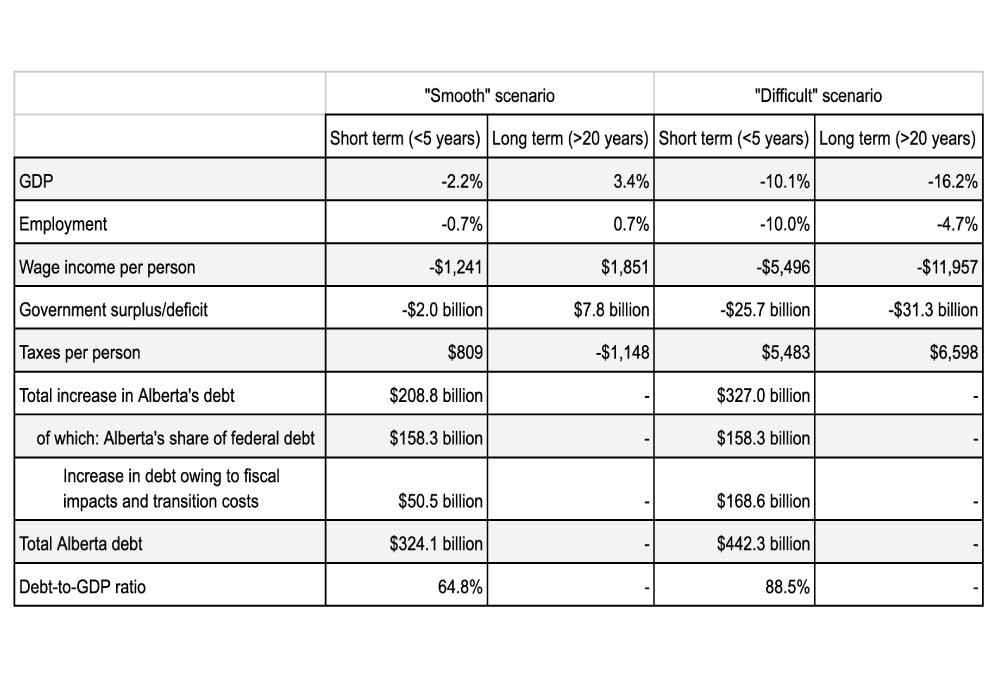
In the smooth scenario, the report assumes that Alberta takes over federal responsibilities relatively easily without high expenses, trade continues without interruption, interest rates eventually return closer to current levels and the energy sector expands.
Under those assumptions, Alberta’s GDP would be 2.2 per cent lower in the short term, defined as less than five years, compared with a scenario in which Alberta does not separate. After more than 20 years, GDP would be 3.4 per cent higher.
Employment would initially be 0.7 per cent lower, before reaching 0.7 per cent higher in the long term. Wage income per person would be $1,241 lower in the short term and $1,851 higher after more than 20 years.
For the difficult scenario, the report assumes higher costs associated with providing government services, significantly higher interest rates, increased trade costs with Canada and a larger discount on Alberta oil due to the U.S. taking advantage of Alberta’s limited alternatives for oil exports.
GDP would be 10.1 per cent lower in the short term and 16.2 per cent lower after more than 20 years. Employment would be 10 per cent lower in the short term and 4.7 per cent lower in the long term.
The scenario estimates wage income per person would be $5,496 lower in the short term and $11,957 lower in the long term.
In both scenarios, Alberta’s debt would increase due to transition costs and fiscal impacts of separation, rising to $324.1 billion in the smooth scenario and $442.3 billion in the difficult case.
Government services
An independent Alberta would have to assume responsibility for the programs and services currently provided by the federal government.
The report identifies Old Age Security, Employment Insurance and the Canada Pension Plan, along with defence, border security, immigration and other federal responsibilities, as areas where an independent Alberta would have to develop its own systems.
That transition would require significant spending on employees, training, information technology, buildings and other infrastructure.
“Even in the most optimistic case, there would be significant transition costs,” the report states. “We estimate that a separate Alberta could require an additional 70,000 public servants.”
The report estimates transition costs could reach $50 billion over five years.
There would also be potential savings. Alberta would no longer participate in programs such as equalization and costs associated with official bilingualism. However, the report notes that a separate Alberta government could be less efficient due to administrative costs that would have to be spread across a smaller population.
An independent Alberta would also no longer be subject to the Canada Health Act. This act currently prevents Alberta from implementing a mixed public-private health-care system. In a separate Alberta, it would be possible to choose which health-care system to use.
More dependence on U.S.
Because Alberta is landlocked and highly dependent on exports, the report identifies trade and access to markets as major uncertainties.
A separate Alberta could have greater freedom to establish its own energy and environmental policies, but its reliance on U.S. infrastructure could also leave Alberta with fewer options when negotiating agreements.
“Separation could make Alberta more dependent on shipping oil through the U.S., which might be co-operative, or which might try to take advantage of Alberta’s lack of other options,” the report states.
Regardless of whether an independent Alberta finds productive ways to produce oil and get it to markets, it would still be vulnerable to swings in oil prices.
Additionally, Canada could decide that it would no longer benefit from new pipelines, such as the proposed West Coast pipeline.
“The U.S. might feel that it could drive a hard bargain with Alberta over energy access, as Alberta would have less access to alternative international markets through Canada,” the report reads. “The U.S. could easily ask for a significant share of pipeline revenues and reduce access even on existing pipelines as a negotiating tactic.”
Advisory panel assessment
The independent advisory panel that reviewed the University of Calgary’s report provided its own assessment in a Sept. 8 letter to the President of Treasury Board and Minister of Finance.
“In our view, the overall conclusion would remain – short-term costs and uncertain long-run gains at best, if at all,” the letter reads.
The panel reminds Albertans that separation would have fiscal and economic impacts on the rest of Canada as well, including a three per cent trade deficit, a lower Canadian dollar, a higher federal deficit, increased inter-provincial trade costs, a 15 per cent GDP decline, reduced trade access to British Columbia, and potential encouragement for Quebec to separate.
“It is important for the rest of Canada to understand that they will clearly be better off if Alberta remains. Hopefully this realization will result in more effective and accommodating responses to reforms that Alberta has requested over the past four decades,” the letter states.


