
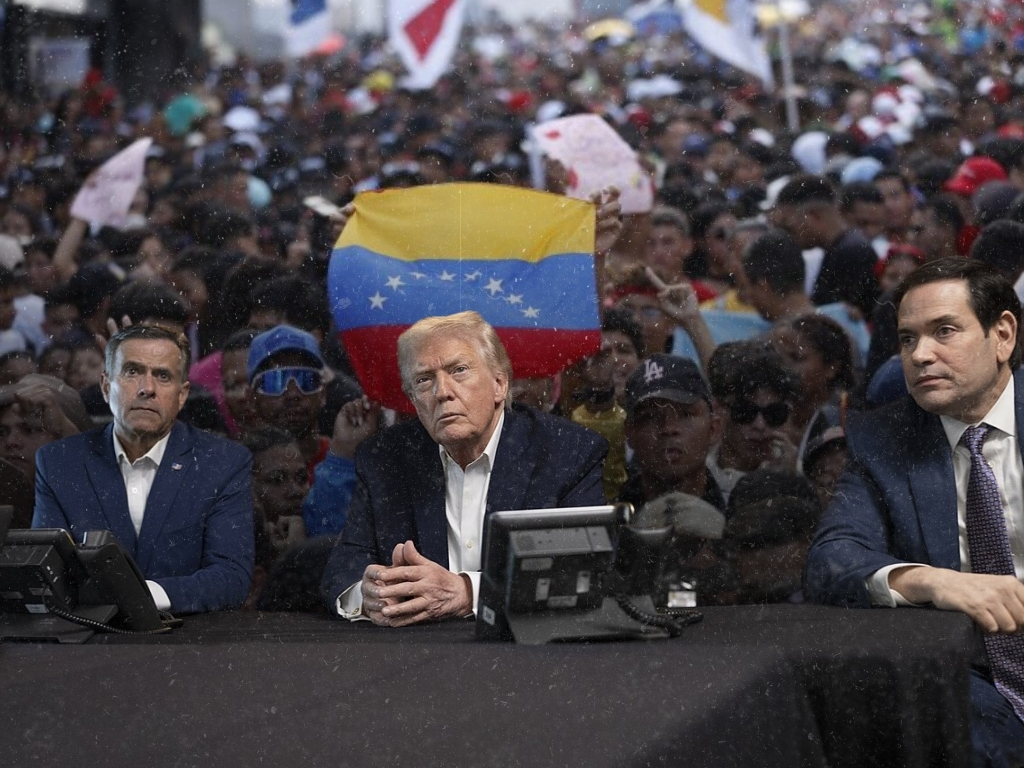
Peace, democracy and the cost of intervention in Venezuela
By Fernanda Scheid Sallet, March 3 2026—
What does peace look like when it arrives in the form of sanctions and soldiers? In Venezuela the United States (U.S.) says it is defending democracy. Yet the reality happening on the country tells a far more complicated story about power sovereignty and who gets to decide a nation’s future.
For decades, the U.S. has positioned itself as a global guardian of peace and democracy. This narrative repeats itself across press releases, political speeches and media coverage, shaping how international conflicts are understood by the public.
Countries facing political instability are often framed as places in need of American guidance or correction, and now Venezuela — with its vast oil reserves, strategic location and ongoing political turmoil — has become one of the most prominent stages for this story. Yet, when we look beyond the ideas of peace and freedom, a more complicated reality begins to emerge: one that often prioritizes power and political influence over the everyday lives of Venezuelans.
What the U.S. says vs. what happens
Officially, U.S. policy toward Venezuela has been justified through concerns about democratic decline, corruption and human rights abuses. Successive U.S. administrations have framed their involvement as an effort to restore democracy and protect Venezuelans from authoritarian leadership. On the surface, this framing appears reasonable, but after years of economic pressure and now direct military intervention, it is important to ask whether these actions have truly supported Venezuelans’ right to self determination or whether they’ve simply served deeper American political and economic interests.
U.S. involvement in Venezuela did not begin with the current crisis. Throughout the 20th century, Venezuela was a key supplier of oil to the United States, making it strategically valuable. American companies held significant influence over the country’s petroleum sector, and U.S. governments often supported leaders who protected those interests. When Venezuelan governments later challenged foreign control through nationalization and redistribution policies, relations shifted sharply. This history speaks to a pattern all over the globe in which support for democracy has often depended on whether a government aligns with U.S. economic priorities.
Sanctions and their human cost
In recent decades, U.S. intervention has largely taken the form of economic sanctions. These measures were presented as a way to pressure political change without resorting to war; however, their effects have extended far beyond political leaders. Sanctions have restricted Venezuela’s access to international credit and oil markets, which worsens inflation and shortages while enacting the collapse of public services. Although internal mismanagement has contributed to these problems, foreign pressure intensifies everyday hardship for millions of Venezuelans.
Sanctions are often described as peaceful tools, but they can cause serious harm. When an economy is isolated from the global system, it is rarely political elites who suffer most. Instead, ordinary people face reduced access to food, medicine and stable employment. Framing this approach as a path to peace hides the human cost it imposes.
The “peace” of military action
The idea of peace becomes even more complicated when intervention becomes militarized. On Jan. 3, 2026, U.S. forces carried out strikes in Venezuela and captured President Nicolás Maduro, transporting him to the United States on criminal charges. U.S. officials described the operation as a law enforcement action tied to security concerns; however, international organizations and legal experts have raised concerns about its legality and its global impact.
The United Nations Human Rights Office emphasized that a country’s future should be decided by its own people; even when a leader is controversial or widely criticized, removing them through external force sets a troubling precedent. Military intervention often promises stability, but history shows it frequently only replaces one form of control with another, leaving local populations with little influence over what comes next.
Power, influence and the limits of rhetoric
When viewed more broadly, U.S. actions in Venezuela appear tied not only to democracy, but also maintaining influence in Latin America. Control over oil resources and competition with global powers such as China and Russia continue to shape foreign policy decisions.
Of course, this does not mean the Venezuelan government should be free from criticism. Many Venezuelans have suffered under corruption, repression and economic mismanagement, but external intervention has rarely delivered the democracy it claims to promote.
What should we take away?
As students and global citizens, we are often presented with simplified stories about international politics. Narratives of peace and democracy can be comforting, especially when they cast powerful countries as moral actors, but peace is more than the absence of resistance. It requires dignity and autonomy: people should be able to shape their own political future.
In Venezuela, what has been framed as an intervention for freedom looks a lot more like intervention for control. The real question is not whether the United States is acting in the name of peace, but who is benefiting from these actions and who is paying the price.
True peace cannot be achieved through economic punishment or military force. It must begin with respect for sovereignty and the voices of those most affected.
This article is a part of our Opinions section and does not necessarily reflect the views of the Gauntlet editorial board.