
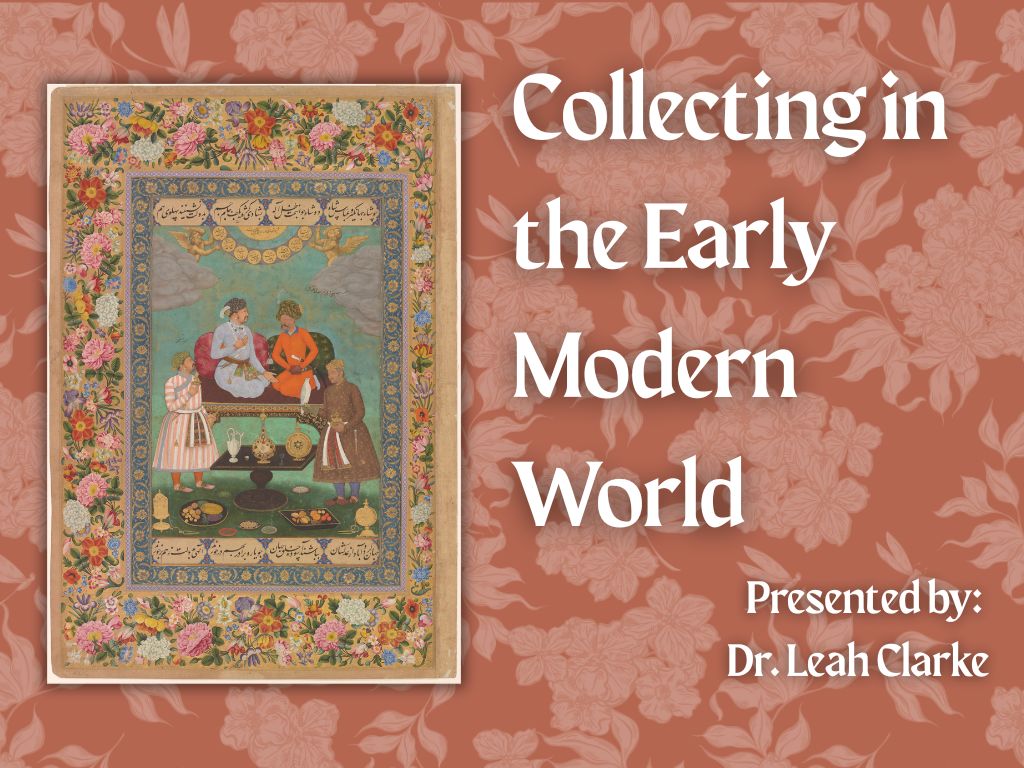
Dr. Leah Clark: Understanding early modern art as a transcultural, sensorial experience
By Sweta Babladi, March 25 2026—
To what extent have we limited our experience of art and other cultural relics by restricting them to the glass exhibits of museums and to the sense of sight? What kinds of shared cultural understandings formed in the past through the global exchange of cultural relics, and who decided what art was worth sharing? How can museums, scholars, curators and anthropologists work to decolonize, and make more accessible, the process of experiencing art?
On Feb. 5, 2026, the Nickle Galleries in the Taylor Family Digital Library hosted a presentation by Dr. Leah Clarke titled, “Collecting in the Early Modern World: Approaches, Methodologies, and Future Directions.” This presentation raised these and other thought-provoking questions about collecting, artistic practices, accessibility and intercultural connection.
Clarke is the Associate Professor and Director of Studies in the history of art at Oxford University, and a Fellow at Kellogg College. Her research focuses on the global exchange and mobility of art in the early modern world. Her most recent publication, “Courtly Mediators: Transcultural Objects between Renaissance Italy and the Islamic World,” explores the exchange of objects between 15th century Italian courts and the Mamluk and Ottoman courts. An important aspect of Clarke’s work focuses on the sensorial experiences of these early works and how they shaped identities across cultures in the early modern world.
In this presentation, these two key concepts of transculturation — the process of cultural transformation where multiple different cultures interact with and influence one another — and the sensorial experiences of art were explained through the analysis of works from different geographical locations in the 17th century.
Clarke referred to a miniature painting by 17th century Mughal painter, Abu’l Hasan, as an example of how ideas and meanings intersect across different cultures and societies. This painting, Jahangir Entertains Shah Abbas, portrays the fictional meeting of two Mughal rulers as two attendants are shown presenting them with gifts from foreign countries. The detail in these objects and their cultural roots carry different meanings for different cultures, and many of them were made to be experienced sensorially. The painting features Chinese porcelain, Italian-style furniture and glassware, and an ornate dagger, all of which are visually pleasing and serve specific functions.
One notable detail is the automaton that one of the attendants is holding, a sculpture titled Diana and the Stag. Attributed to the 17th century German artist Matthias Walbaum, it illustrates some of Clarke’s key points; how exchanged objects between the Mughal and European courts took on culturally-specific meanings as they were traded, the influence these different cultures had on one another, and how experiencing art through senses other than sight help us create meaning out of historical art.
The sculpture, picturing the Goddess Diana on a stag, was used both as a table centerpiece and a drinking game. A clock-like internal mechanism would move the automaton along the table, and when it stopped in front of a guest, they would lift the stag and drink wine from its head. In this way, the automaton originally functioned both as a work of art and a sensorial experience. It is also loaded with symbolism: from questions of gender and voyeurism with Diana as the subject, to the various religious connotations of drinking wine (blood) from the stag’s head. This sculpture’s presence in the fictional painting confirms its role as popular court entertainment during the early modern period, asking viewers to consider how culture may inform interpretation of the work.
The “sensorial subjectivities” that Clarke referred to are ultimately about changing the ocular-centric way that we engage with art today. There has been an emphasis on sight as the highest and most moral of the senses in Western philosophy. Engaging with art beyond the sense of sight first and foremost transforms us from mere spectators to what Clarke calls “beholders,” active agents in interpretation.
Animating these kinds of cultural experiences through the senses help decolonize the methodologies of creating, discovering and curating. It erases many of the hierarchies that have pervaded the world of art: global versus local art, high versus low art, and producer versus beholder. By blurring these lines, new perspectives are brought into focus that would otherwise go unnoticed. Through this lens, clay pots, textiles, and other artwork produced by an ordinary, art created by the average working-class person can be just as valuable as the looming paintings and sculptures that are preserved in national museums.
Currently, Dr. Clarke is co-curating a new exhibition at Oxford’s Ashmolean Museum with. Dr. Geraldine A. Johnson that is set to open in 2027, titled, “Sensory Wonders of the Renaissance World.” The goal of this exhibit is to give visitors a sensorial experience of the Renaissance period, rather than learning about the historical facts through sight alone. It will feature different rooms, each with different sensory exhibits. The museum has also been working with people who have visual disabilities to make the exhibit more accessible by creating raised maps of the museum itself. This hands-on experience is meant to take the historical facts of global trade during Europe’s Renaissance and transform it into a larger-than-life experience of the early modern period.