
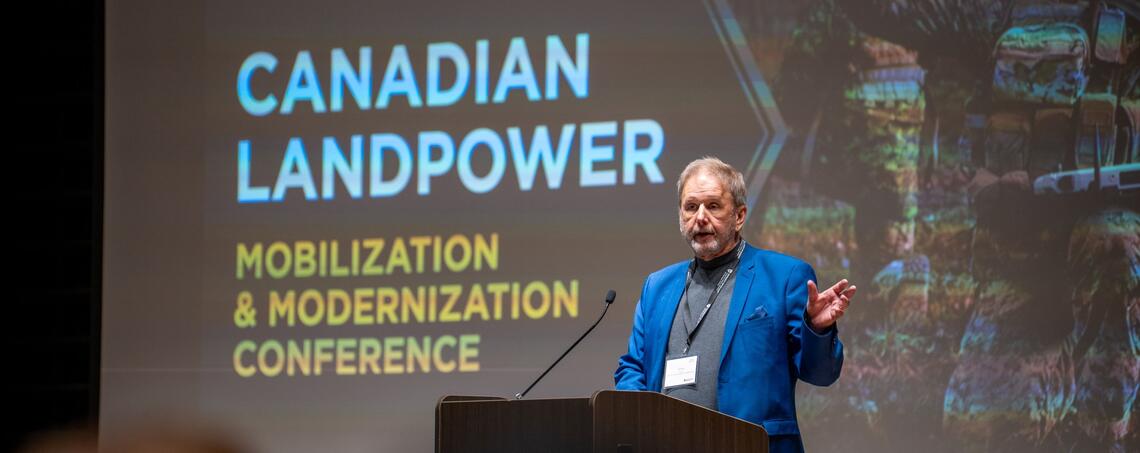
U of C hosts Canadian Landpower Mobilization and Modernization Conference
By Hannah Caparino, May 21 2026—
The University of Calgary (U of C) recently held the Canadian Landpower Mobilization and Modernization Conference on March 26 – 27. The conference featured a wide variety of panels and discussion for how the Canadian Armed Forces (CAF) will employ research and technology in order to modernize. The keynote speakers included Commander of the Canadian Army, Lieutenant-General M.C Wright and General Wayne Eyre, the previous Chief of Defence Staff who retired in 2024.
One of the panels that was led by Dr. Heather Exner-Pirot, Dr. Elizabeth Steyn and Dr. Whitney Lankenbauer introduced the topic of Canadian interests; which explored Canada’s critical resources, sovereignty and alliances.
Exner-Pirot’s research involves the politics of resource development and security; and works with Natural Resources and Environment at the Macdonald-Laurier Institute as the Director of Energy. The panel had discussed how recent military operations and offensive actions targeted energy infrastructures. Each panelist discussed Canada’s own resources that may be targets and areas that are strategic. Strategic areas include the BC and Fernie area that harbours coal, North Saskatchewan and the Athabasca Basin which contains high amounts of Uranium and the east coast which include Iron deposits and Aluminium.
According to Exner-Pirot, the four categories of critical minerals include: minerals that have lots of weight in the global market, minerals important to Canada’s GDP, minerals that are used in technology and minerals that are weak in the market but are essential for security.
Dr. Elizabeth Steyn followed Exner-Pirot in the panel as she spoke about how the critical minerals should be listed and would have to be sourced strategically alongside implementing methods should be transparent. These on the list would include materials produced in Canada, how it serves Canada’s own interests and how we can begin to secure it from threats by integrating these minerals with the CAF supply and production. Minerals include Beryllium, Barium and Borax.
With the establishment of critical minerals, Dr. Whitney Lackenbauer spoke on how mineral security is related to the Arctic operations. Arctic security has been difficult because it is incredibly isolated and leaves Canada vulnerable. Developing infrastructure in the Arctic was also proposed by Lackenbauer as a way to strengthen Canada’s reputation and security from external threats. The CAF had recently been working with the Canadian Rangers to learn how to work and live in harsh environments. Recent efforts like “Operation NANOOK 2025: Strengthening Arctic Defense and Sovereignty” outlined the CAF’s goals to develop Arctic defense tactics and share that information with allies going forward.
Another panel that had taken place at the conference was about the relationship between technology and modern operations. With the increase of technology in the past 20 years, warfare and operations have grown from theatre-level operations to external operations.
Part of the panel was author and editor of the Military Strategy Magazine, William F. Owen, Dr. Rebecca Jensen from the Canadian Forces College and Lieutenant Colonel Jan Strbik from the Czech Army; the NATO DIANA UAS Challenge Manager.
Each speaker had initially discussed how international movements and efforts like NATO DIANA are intended to develop and integrate technology into the armed forces through training and investment. All NATO allies are each trying to modernize by working with leading researchers to combat any defense, security and technological weaknesses.
As part of the CAF’s modernization, innovation would highlight how inoperability was achieved through slow technological adaptations and how interest, the use of platforms and data constraints limit progress. Adoption of technology was spearheaded through the MINERVA Initiative to equip CAF members with modern technology and share it with allies and allied movements. One primary problem with modern warfare is that visibility leaves forces vulnerable and lessens an individual’s survivability.
In the next few years, the CAF aims to increase its fighting power by setting up deployable brigades that can be employed anywhere. These brigades are meant to be equipped with the technology and hold the funds to mobilize in an efficient manner. The educational infrastructure within the CAF would need to reflect the tactics that will be used to be successful in operations.
For information on the other panels at the conference, see the CMSS website.