
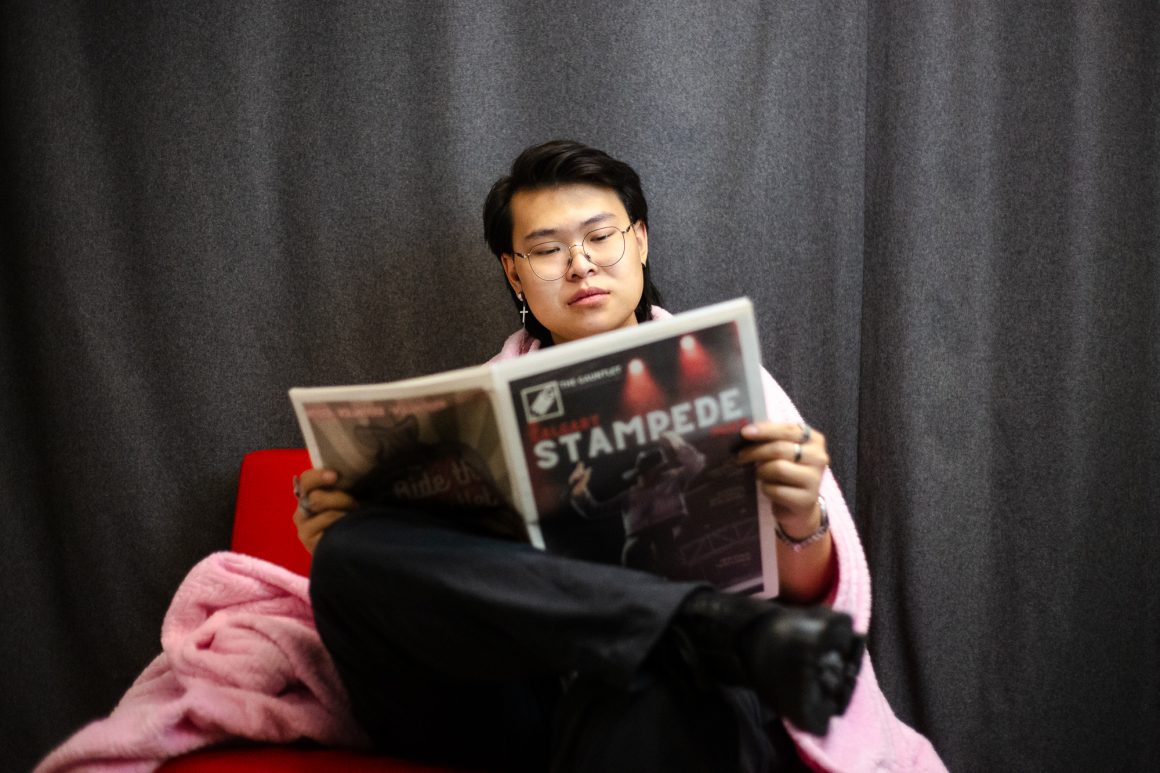
FROSH: Why you should read your student newspaper
By Cameron Sauder, September 11 2025—
Reading the Gauntlet is about more than just staying up to date: it’s about creating and supporting a campus community of collaborative knowledge production and empathy.
What is a student newspaper? If you’re reading this, you might have a half-decent idea, but it’s always nice to get a refresher. A student newspaper — like the one you’re holding in your hands or viewing on your electronic device — is a publication entirely by students and entirely for students.
That means we write about what we want to write about, and we do it for the sake of the largest demographic at UCalgary: the students.
Now, I may be new to this university, and I may be new to the Gauntlet, but I am no stranger to student newspapers, nor the common perceptions of them. People might say we stick our noses in places they don’t belong, or that we’re too political for our own good, or they might not even know we exist at all.
However, when we meddle, we do it for you. We dive into topics that can be unsavoury and get critical about subjects that make us upset, allowing the truth of the matter to be exposed and explored by people who may not be privy to it. If the university makes a decision that harms the student body, we’ll be there criticizing that decision.
The same is true of the opposite. If the university makes a decision that supports its students, we’ll applaud that positive contribution. More than that, you’ll find that we celebrate student achievements and do our best to support your life as a newly inducted academic. Whether that’s by giving tips on the best ways to make new friends or see the city, imparting our experiences on how to study efficiently, or baring our deepest passions with you in the hope that they might be recognized and shared by more than just one lonely writer.
But what does it all mean? “Quit your preaching and get to the point,” I hear you saying.
The point is that none of us here at the Gauntlet do the work that we do for only ourselves. We write to share knowledge, we write to share passion, and most importantly, we write to share stories — whether they’re our own or other people’s.
COVID-19 and the rise of the social media empire have bungled a lot of us up: so many people are suffocatingly lonely, even with the whole world at their fingertips. Genuine human connection is in short supply, and many young people are hesitant to take up space.
Except when you refuse to fill space, that space is taken up by people who pollute the air with their incessant, noisy rambling of misinformation and genuine hatred. That’s not how the world should be. That’s not how knowledge is produced.
People like Donald Trump get elected because genuine knowledge is in short supply — blocked by algorithms and caged out of MAGA rabbit holes by fearmongering rhetoric — and because apathy among the rest of us seems to spread like a disease.
Student apathy, especially, is a viral strain. The university setting should be radical: we’re a microcosm of society, able to vote for our own student representatives and use platforms like this very newspaper to share our opinions and spread important information. So why not use these opportunities?
When you participate in this community of knowledge sharing – by reading or writing for the Gauntlet, by talking about pertinent topics with your friends, etc. – you help create the type of community that produces valuable information. Student journalists truly are nothing without a student audience to communicate with.
If you’re going to complain about the Gauntlet, don’t do it on Reddit: submit a Letter to the Editor and engage with us directly, especially if you’re responding to a specific story. As long as you’re not being discriminatory, we’ll publish it. That way, we create a public, collaborative conversation. If you want to commend the Gauntlet or share your approval of a story we wrote, do the same thing — we don’t mind!
If there’s a story we haven’t covered, you could be the one to tell it: sign up for a volunteer orientation on our website to meet Ilana van der Merwe, our Volunteer Coordinator, so you can see story pitches, pitch your own ideas and contribute to the paper.
When we work together and communicate, even if we don’t see eye-to-eye on everything, we can produce something really quite magical.
A very smart woman once told me that the purpose of the Humanities is to teach empathy. When you read a novel, for example, you are thrust into someone else’s shoes and forced to experience the world as they do.
Student journalism is a lot like that. Stories in bigger news outlets may seem beyond our scope of understanding, beyond our capacity for empathy, but student journalism is about your neighbours. It is written by the people you may see in the hallways at school, and it’s written about topics that are happening all around us, in our very own stomping grounds. To be apathetic about student journalism is to shut yourself off from the community around you, and these days, we can’t afford to be alone anymore.
So read your student newspaper, even just a little bit. Your soul will thank you.
This article is a part of our Opinions section and does not necessarily reflect the views of the Gauntlet editorial board.