
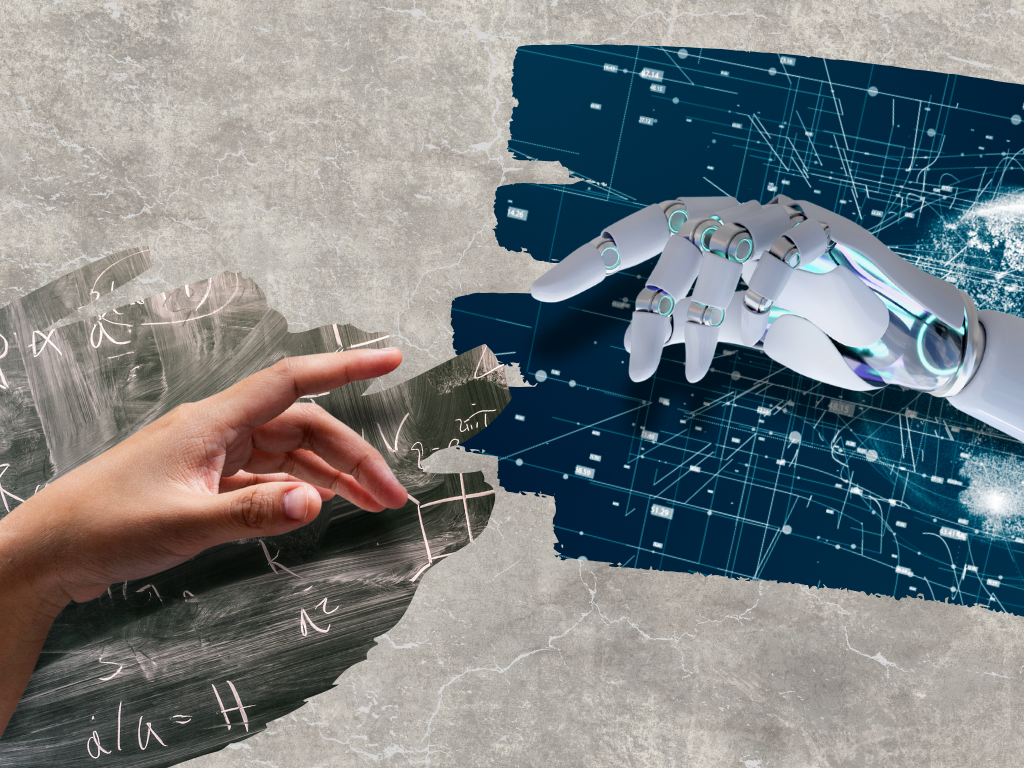
Whether we like it or not, AI will change our education
By Anna-Maria Kulykova, October 25 2025—
Artificial Intelligence (AI) needs to be explored and utilized in ways that will help advance students’ comprehensive understanding of different concepts. However, AI use has to be monitored and limited to some extent because of the damage it does to our minds and human uniqueness.
There was a time when we knew nothing about how our bodies functioned, because the idea seemed to be irrelevant and futile. Now, not knowing about these topics is deemed abnormal, as understanding how our digestive, respiratory and other systems function has benefited our lives in unimaginable ways.
This may not seem relevant, but the progression and function of AI systems is quite similar: many people know AI and the resources it provides fairly well, but countless others are entirely unacquainted with it.
Nevertheless, the amount of people who use AI on a daily basis will eventually become more assertive and influential, creating a new standard where being unaware of AI will be irregular.
AI is an intelligent computer system that can help students ease their daily lives by performing tasks, providing information and analyzing data. Instead of checking textbooks or using Google to find information, we are able to just ask AI, and we will be given an answer — those answers can even be relayed to us in a human-like voice if we so choose.
As students, this can become a tool to answer our questions at any time or place, which makes it seem more suitable than having to wait for a reply from a professor during office hours. However, while AI explanations may seem more optimal for students who don’t understand in-class concepts, it’s crucial to self-monitor the types of questions we’re asking AI, as hallucinations can lead to confident, yet misleading or straight-up wrong answers. Asking a general question of a course material or reading may be helpful, but going to a professor is always your best bet.
Still, despite AI being marginally useful, it is lowering our human authenticity and ability to practice critical thinking skills. A study released by the Massachusetts Institute of Technology (MIT) earlier this year showcased multiple experiments that revealed these effects. The information received from these tests showed the decrease of human neural connectivity in people who use and rely on AI. Our neural connectivity creates constant synapses in our brains, helping us transmit thoughts, process information and help us feel the way we are, and losing it could mean losing ourselves.
Critical thinking skills are necessary for students because we are expected to organize, memorize and understand all of the material given to us each day. Interestingly, an important point made in this article is that removing all AI use is not the proper course of action. As Time reporter Andrew R. Chow explains, “the hope [is] that AI, if used properly, could enhance learning as opposed to diminishing it.” Hence, it is important to start implementing and teaching students what precise ways AI should be used to enhance our brain productivity, like brainstorming ideas and organizing tasks.
Now that the academic year is well underway, instructors will have made crystal clear their policies on AI usage. Some have encouraged its use, while others make AI strictly forbidden, considering its use to be academic misconduct.
But banning AI use is not helpful, as students will use AI whether they’re permitted to or not. It is better to show students where and how they can use AI to help them achieve maximum understanding in their coursework rather than having students hide their AI use and potentially abuse the tools it offers.
AI can provide countless ways of learning and understanding without breaking any codes of misconduct, such as providing context or elaborating on complex concepts. This type of AI use is vastly different from having AI write or complete assignments in their entirety. Differentiating proper from improper AI use should be the norm for professor’s guidelines, because while it is foolish to ignore AI, it is harmful to use too much of it.
Abusing generative AI is an affront to human ingenuity and innovation across history. AI may consist of millions of complex lines of code, but is nothing compared to the billions of neurons that traverse the trillions of synaptic connections in our brains that make each human being a separate, unique individual. We all carry unforgettable memories and stories — as well as unique ethics and morals — that are completely priceless in comparison to the mindless functions of an AI program. Trading our innate curiosity and ingenuity for a much easier and convenient way to get an assignment done is not only a waste of your time and money, but it’s straight-up unethical. It is unethical to give up our human authenticity, effort and thoughts after humans have spent centuries learning, adapting and advancing beyond measure.
But AI will still be here whether we like it or not, and pretending like we can completely get rid of it is not going to change anything. Universities need to implement firmer guidelines around AI use and expand the methods by which students and professors can work with AI in academia. At the same time, AI detectors like GPTZero, and special AI-detecting programs implemented in digital writing assistants, like Grammarly, need to be implemented to politely force students to use their brains instead of relying on AI.
This way, students can advance and modernize their learning while keeping their unique personalities a core component of their work.
This article is a part of our Opinions section and does not necessarily reflect the views of the Gauntlet editorial board.