
“The way is easy that leads to destruction:” Oceania in 2025
By Anya Bredenkamp, October 29 2025—
1984 isn’t just a dystopian novel — it mirrors aspects of the potential future of the world I find myself in.
Briefly, 1984 is an arguably prophetic dystopian tale about a man actively battling with truth and his understanding of it. The book walks us through the extensive range of human emotion that our main character, Winston, experiences as he gradually starts to live life on the edge and his daily dissent against autocracy gradually catches up to him. However, the edge comes closer than he foresaw when his secret life of objection against a flagrantly deceitful government comes crashing down.
In 2025, we live in a society full of people afraid to offend their peers, where the government knows what toppings you like at Domino’s and where your controversial views can be enough to earn you a bullet to the neck if you’re well enough misunderstood.
If you ask me, the biggest crime Winston committed in 1984 was not murder, treason (as we know it to be) or fraud — it was having the courage to freely speak and act as he pleased. And the reason he got caught? Because privacy was a myth he never had the privilege of utilizing.
I observed several distinctive similarities upon my reading of 1984 to my motherland, Canada, the first and most prominent of these being privacy.
The omnipresence of the telescreens in 1984 was a clearly brilliant prediction of future technology. These are devices like enormous tablets hardwired into the walls of your home. They have no off button and are always watching your behaviour. In other words, it’s never just you in a room. They also punch out a nauseating concoction of propaganda, music and fake news, all tools used by the state to chloroform the citizens of Oceania into submission.
To me, the telescreens sound a whole lot like the iPhone I bring everywhere with me. I know the government doesn’t care about tracking how long it takes me to do the Wordle every morning, I know they aren’t looking at me through my laptop camera as I am writing this, but the potential is there. They have access to personal information I unknowingly shared through “data merchants” like Oracle, Cleanlist, and Data Axle Canada. These companies collect user data, analyze it and use it to target ads — meaning the Instagram ads for specialty shampoo, wallets or charities you see aren’t random but tailored to your digital footprint.
Now, I personally lose no sleep over personalized ads because I’ll admit, I do want to know about the deals at Costco. However, I’m more concerned about who in particular has access to my information, because although data merchants like Data Axle are privately owned companies, they still provide services to thousands of government agencies, meaning your activities are literally in the hands of the government too.
I view the privacy problem like this: We are living in the safe, free days before mass digitization occurs (yes, I see potential for it to get worse) and “safe” technology like phones become weapons. George Orwell gave us the likely outcome, or the “after,” in 1984. In the book, the government knows everything, weaponizing technology to conform society, and that’s no secret to the citizens of Oceania.
Meanwhile, in 2025, our governments have every single tool at their disposal to know everything, and people are desensitized to the extent of big government’s ability to track and manipulate us. Take Winston’s diary — it was enough to convict him because the mere idea of secret protestation was criminalized, and they were able to use it against him. Today, our equivalent to diaries are Instagram DMs, search histories and online subscriptions.
Under the wrong regime, any one of these could be used to destroy us. You liked a comment on X that was openly bashing Mark Carney? That’s fine now, but as the government unnoticeably and gradually accumulates more power, you’ll be screwed, and no one will be able to save you.
We live in a democracy now, and the current reality of data privacy in Canada is tame compared to in 1984, but the skeptic in me can’t seem to shake the churning question of what if we became like that? Because we already have everything we need to make 1984 a reality.
Comfort blinds us more effectively than terror, which Yuval Harari explores deeply in his book Nexus (read it if you know what’s good for you). We hand over our privacy for convenience — banking apps, online orders, Uber rides — and one day, we’ll wake up to realize we’ve lost it entirely.
The second and most culturally relevant similarity between us and 1984 is the environment around speech and the lack of freedom.
There is a central value of The Party (the name for the ruling government) and Ingsoc (the name for autocratic socialism): what I call unity without singularity. Put differently, a devoted Party member would believe that the people are united because they are all the same.
Now, you might be thinking to yourself, what about people who disagree or don’t fit the ideological mold? Cue Newspeak, the language meticulously curated by The Party. In the appendix to my version of the book, Orwell dissects exactly what Newspeak is:
“The Purpose of Newspeak was […] to make all the other modes of [outlawed] thought impossible. It was intended that when Newspeak had been adopted once and for all and Oldspeak forgotten, a heretical thought — that is, a thought diverging from the principles of Ingsoc — should be literally unthinkable.”
In the novel, The Party literally makes thinking negatively against the government impossible. If that isn’t completely genius and frightening at the same time to you, wake up, sheeple!
Like the aforementioned topic of privacy, freedom of speech is a right that has been stripped to the ultimate extreme in 1984, and I realize that. But let’s just take a moment to unpack what “freedom of speech” gets you in Canada and the USA.
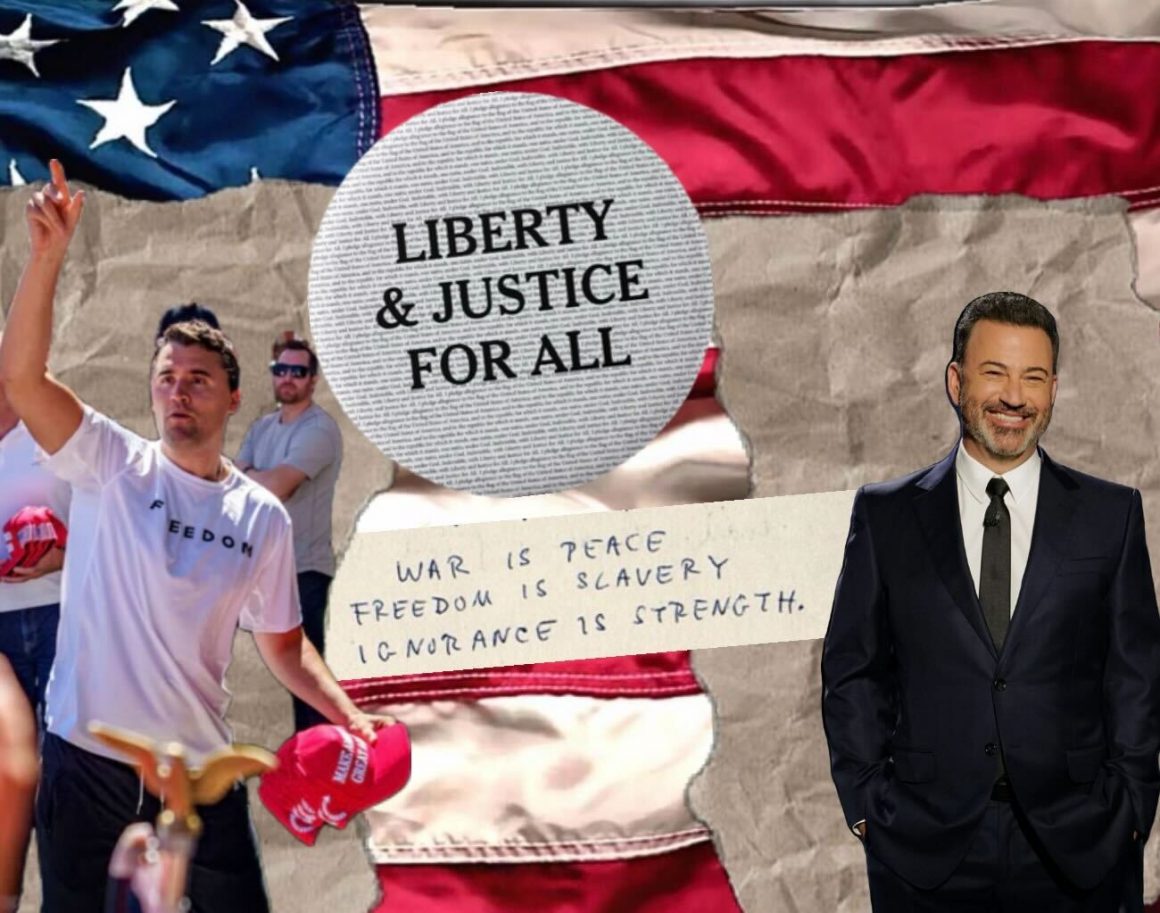
My natural first thought is Charlie Kirk, an American hero who practiced what he preached and humbly debated with anyone willing to disagree with his takes, who was fatally shot in September 2025 in front of a crowd of university students. For context, Kirk was open about his hot support for increasingly stringent borders and gun rights, criticism of D.E.I. initiatives, and a Jesus-centred worldview. Needless to say, he was controversial. His debates were open to anyone, voluntary and easy to simply walk past and ignore if one so chose. Leigh Allyn-Baker said it best: “He died defending your right to disagree with him.”
In the wake of social uproar, Kirk’s death caused a fury of either strong support or grief online. Among the supporters of the assassination were people who were doxxed and reported to a site by their fellow internet users, after which many were fired for their online comments. During his appearance on the Charlie Kirk show shortly after Kirk’s death, American Vice-President JD Vance said, “Call them out, and hell, call their employer,” in response to the rampant online support of the shooting. Alongside this, President Donald Trump released a video statement proclaiming his condolences and condemning the violence. Although I share in Trump’s grief, when he says “this kind of rhetoric is directly responsible for the terrorism we’re seeing in our country today” and that “[r]adical left political violence has hurt too many innocent people and taken too many lives,” he walks a dangerous line between expressing his condolences and inciting further violence.
Although Kirk’s murder was an isolated incident, the shockwave it sent throughout right-wing groups speaks volumes about the leaders we have in power. The disapproval from Trump and Vance was justified, but branding their political opponents as terrorists is the opposite of what needs to be done to unite that broken nation. We saw in 1984 that speaking against Big Brother was cause for imprisonment, at best. Even though we haven’t gotten that far yet, the rise of extremist ideologies like ANTIFA and Active Clubs shows how easy it is for increasingly extreme politics to become divisive and violent on either end of the spectrum, potentially (and we are already seeing this in Portland) prompting direct state intervention. If you don’t think that sounds like the origin story of 1984, then we may be in a worse place than I thought.
If you’d rather a similarly alarming local example, look no further than Sept. 29 in Calgary, when, at an Alberta Next panel, a Grade 12 student tried to question the province’s private school funding relative to the funds allocated to public schools in an effort to highlight a driver for the Alberta teachers’ strike.
The kid got hit with a double whammy: first, the mic was cut mid-question, a dirty move; then the moderator, Bruce McAllister, said, “I know you’d love some chaos, but your parents should turn you over your knee.” All that drama and dehumanization for trying to ask a fair, logical question.
Danielle Smith, our Premier, later appeared to defend McAllister: “None of us are perfect and it’s a very stressful environment to be in, to be moderating events like that. And he made an offensive comment and apologized for it this morning.”
That’s a lot of words to say she didn’t care.
Our leaders are directly in control of the ways we are able to express ourselves. Donald Trump controls the direction of his nation and by default the actions taken by the Democratic party, and Danielle Smith clearly has no problems with the way this teen was addressed. Democracy hinges on freedom of speech, and when we see that start to fade, the political landscape shifts in a terrifying direction.
In 1984, Winston is beaten and tortured until he confronts and accepts the ideals of Ingsoc via Newspeak. The Party beats into him a concept called doublethink, unique to the world in 1984 (but a concept well known to many of us), which is believing a lie as if it were true, which The Party relies on to get away with evolving narratives and glaringly obvious lies. Winston spoke out as quietly as he could, but it cost him the most intimate asset he had: his intellectual freedom. The way I see it, when people start being unable to speak for the fear of being reprimanded, we’ve lost the plot.
I am a big believer in dialogue, and I value hearing diverse perspectives. However, an unfortunate fact is that I know people who don’t. I’ve noticed online that people viewed as right-leaning tend to be automatically generalized as Nazis. Similarly, at least from what I’ve heard, individuals on the left get grouped as snowflakes. But this name-calling, reducing people to offensive titles, is the best example of the widespread behaviour that does nothing other than feed the flames of political polarization and radicalization. The intolerance for differing viewpoints is the foundation of society in 1984, and it seems to be a slippery slope.
Although it is not fair to say we are like the society in 1984, I would argue we are getting too close for comfort. This novel was not just a good read — it was a warning. Privacy and free speech are fragile, and every excuse we make for convenience or silence edges us closer to dystopia. An easy online order for a late-night snack or a microphone cut off mid-question seems harmless now, but en masse, they affect the social and political climate. The relationship between democracy and oppression is more interdependent than we may realize. It’s up to us to decide which side of the page we want to live on.
This article is a part of our Opinions section and does not necessarily reflect the views of the Gauntlet editorial board.