
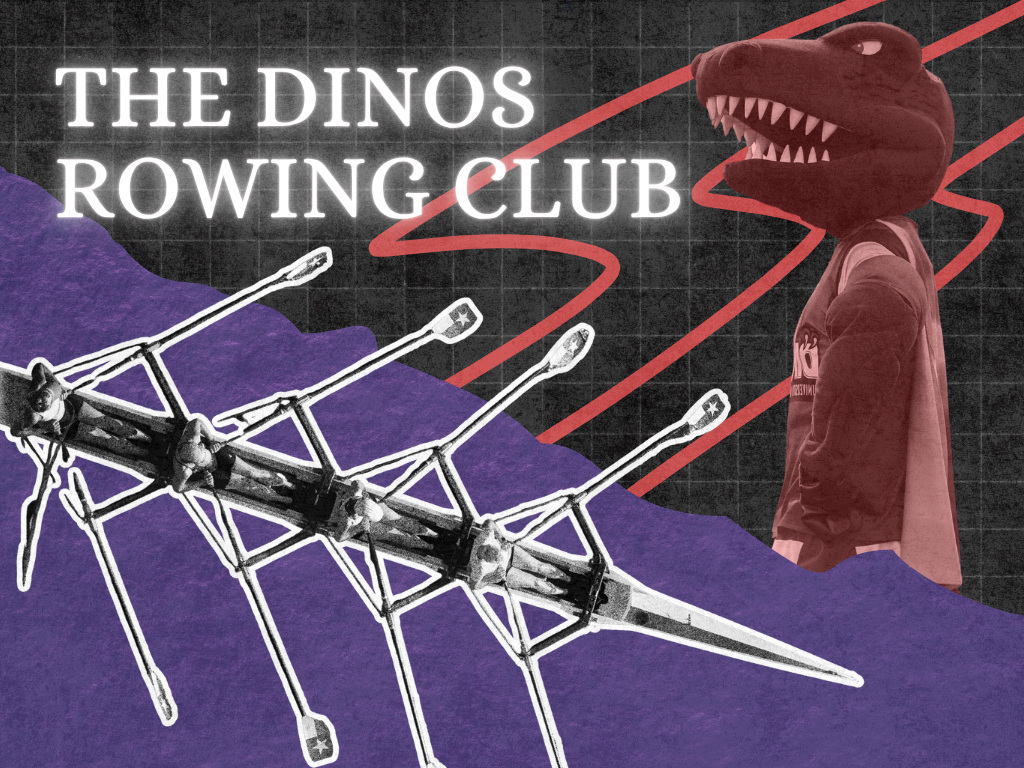
Rowing towards legacy: Inside the Dinos’ rowing club
By Leigh Patrick, November 15 2025—
The Dinos Rowing Club launches before sunrise, striving for excellence in silence. No crowds. No scoreboard. Just discipline, precision and the determination to keep showing up. A niche sport often overlooked amid the noise of varsity games, the Dinos Rowing Club is a force to be reckoned with. Ranked fifth in the country, the club consistently exceeds expectations despite being a club sport with no university funding, formal recognition or strong fan support.
“We’ve been fighting for that [varsity status] for quite some time,” said Norah Chan, president of the rowing club. “To a certain degree, we do deserve funding from the university, but that hasn’t happened yet.”
The grind: Rowing’s silent brutality
Contrary to its elegant appearance, rowing is one of the most physically punishing sports an athlete can endure. The standard two-kilometre race distance is a unique form of agony. “It’s right on the line of a sprint versus aerobics, so you’re maxing out every stroke,” said Chan.
That intensity is most famously on display during the weekly two-kilometre test on an ergometer (ERG). The ERG becomes a crucible of pain and performance.
“A two-k on the erg is probably the worst physical test I’ve ever done — it’s horrible. It’s worse than a beep test. It’s just like a nightmare,” said Chan.
The physical toll is so intense that buckets are placed beside machines as an unspoken ritual of endurance. That’s just one part of the schedule. The club trains eight times a week on the water, with extra lifts and cross-training sessions. Summer practices are at 5:30 a.m., and winter sessions start at 6:00 a.m.
“Everyone has their own workout and it’s customized to your lifting ability at that point,” said Chan. “[The program] is done by our strength coach, Landon. Because he’s amazing.”
The varsity problem: Elite results, club-level budget
With approximately 80 athletes divided into varsity, junior and novice squads, the Dinos Rowing Club runs with the intensity and structure of a varsity program — but without the funding or recognition. Athletes cover their own physiotherapy costs. Executive members volunteer countless hours to manage logistics, registration and race coordination to keep the club running. Coaches, paid little, hold secondary jobs while dedicating early mornings and weekends to the club. For this program to function, it’s passion over profit. The club’s success isn’t built on institutional support — it’s built on determination.
But that determination is constantly tested. Alberta universities only grant varsity status to sports competing in U SPORTS, Canada’s national governing body for university athletics — a designation that rowing does not have. Despite national rankings and elite results, the Dinos Rowing Club remains outside the varsity umbrella.
“We’ve had conversations with Dinos Athletics Club, asking, Why does this have to be this way?” said Chan. “You know, we’re doing better than a lot of varsity teams in terms of standings. We’re fifth in the country right now.”
While Chan believes the club deserves university funding, she also recognizes that the decision isn’t entirely in Dinos Athletics’ hands.
“Dinos Athletics does what they can in terms of the regulations they face,” reflected Chan. “The athletic directors are pretty good about making sure we have as many opportunities as they can give us.”
A late entry sport: Barriers to the boat
In Canada, rowing is typically discovered in university, making it a late-start sport. Junior programs tend to be expensive. Infrastructure is limited. Exposure remains minimal — even spectating is challenging, especially in Calgary, where races cover two kilometres on Glenmore Reservoir with restricted visibility.
“In Canada, it’s not a big thing,” said Chan. “The only universities that really fund the rowing clubs are UVic, UBC and then a couple of the Ontario ones.”
Despite the barriers, the club attracts a particular kind of person: focused, precise and somewhat perfectionist. Rowing involves repeating the same movement thousands of times. While it is a club sport, athletes avoid talking in the boat during races or practices. Instead, much of the work happens in your own head.
The demands of a competitive rowing club conflict with the typical university social experience. Such an intense training schedule requires a level of discipline that leaves little room for late nights or casual partying. As a result, the lifestyle sharply contrasts with that of their peers.
“[Rowing] definitely made me more of a grandma in university than I was expecting. You join rowing and you’re cooked immediately. Not a lot of the bar or club scene is happening in the club,” Chan shared.
You get what you put in
What rowing lacks in visibility, it makes up for with a close-knit community where athletes study, commute and celebrate together.
At the finish line, there’s a flurry of high-fives, rocking boats and the kind of joy that comes from shared struggle. With top-tier coaching, extensive training options, travel and community all in one package, Chan estimated that the cost for a dedicated athlete attending all practices is as little as “$2 to $3 an hour.”
The club competes in regattas across North America, including the Canadian University Rowing Championships, the Dino Sprints Regatta and the Western Canadian University Rowing Championships during the 2025 rowing season. In the past, the club has participated in the San Diego Crew Classic and the Head of the Charles, a competition held in Boston.
But the ultimate goal is bigger than medals or status. Chan’s long-term goal is to build a program that can rival the best in the country. She pointed to Calgary’s strong rowing community. She emphasized that with improved training facilities, more funding and stronger recruitment strategies, the team could be the top on the West Coast and the best university rowing club in Canada.
“I think it’s possible, “ said Chan, “The next 10 years for sure.”
That vision isn’t just about winning races; it’s about creating a legacy. One built on consistency, competitiveness and a culture that athletes want to grow with. The Dinos Rowing Club continuously shows that excellence doesn’t wait for permission and that passion is the strongest motivator. With every early morning and every two kilometres, the club redefines what it means to show up.
For each other, for the sport and for the legacy they’re creating.