
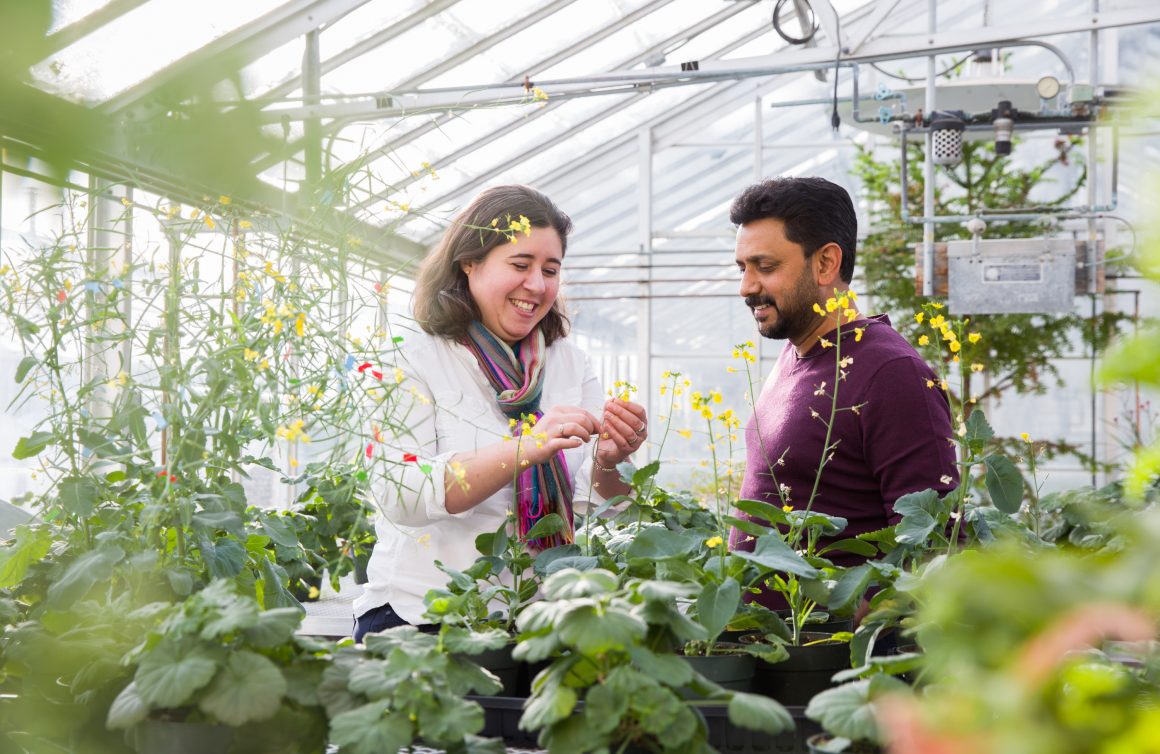
Researching plant genetics and innovating the agriculture industry: The Marcus Samuel lab
By Laura Beldor, November 24 2025—
Marcus Samuel, a professor in the Department of Biological Sciences at the University of Calgary and director of Greenhouse Operations, is a plant geneticist who has made significant contributions to the study of the genetics of canola. Today, he has his own lab where multiple individuals, post-doctoral researchers, graduate students and undergraduate students are investigating the genetics of a variety of crops grown in Canada.
“In the lab, we do a lot of translational research. Which entails looking more at agricultural crops and trying to either increase drought resistance, or increase protein production,” said Justin Nichol, a University of Calgary post-doctorate and manager of Samuel’s lab.
Canola was first developed almost 50 years ago by Canadian scientists. Today, it is one of the country’s most profitable crops, with the industry surrounding Canola generating billions of dollars per year. Today, work to improve the crop is continued at Samuel’s lab, where researchers are currently looking for ways to modify canola plants to be more tolerant to the hot and dry climate of the Canadian prairies, where the majority of the crop is grown. Members of the lab are also looking into ways of improving seed collection for farmers by increasing shatter tolerance, or reducing the amount of seed pods splitting before harvest, in canola.
“The [canola’s] pod fruiting body likes to open up and spread out and that’s how it distributes the seeds,” said Nichol. “That’s not really good if you’re a farmer, right? You want to have those seeds. So we look at other genetic ways that we can manipulate the fruiting body so it doesn’t pop open.”
Along with canola, the lab works to improve the drought tolerance and disease resistance in other crops such as soybean and chickpeas. Crops that are staples in Canadian diets and are lucrative to the country’s economy.
The lab partners with and receives funding from various sources, such as individual farmers and large companies in the agricultural industry. Some larger companies include Nutrien, TMAC Agro Canada and Le Groupe Bruelier. These partners not only provide financial support for the lab to conduct their research, but they also supply the lab with field space in order to grow their genetically modified crops.
“We do large field trials. These are either in Alberta, Saskatchewan, or Manitoba, depending on which of our partners we use,” said Nichol. “[The companies] actually have their own farmers that are doing the field trials.”
Along with their research, the members of Samuel’s lab give back to the University of Calgary community by growing food for students. The lab partners with the university’s greenhouse to grow various fruits and vegetables.
“What we’ve been able to grow has been basil, radishes, green onions, cherry tomatoes, cucumbers, zucchinis and eggplants,” said Nichol.
The members of Samuel’s lab understand the importance of their work for the future of agriculture. The effects of climate change, such as warmer temperatures and changes in precipitation, can negatively impact the yield and quality of crops. The individuals who are a part of Samuels’ lab are working towards modifying plants in order to be able to grow in these conditions.
“Plants can evolve to fit their environments, but if the climate is changing too rapidly for them to acclimatize to this, that’s where the solutions that the GMOs come into play,” said Nichols.
At the U of C, The Marcus Samuel lab is at the forefront of research in plant biology. The work being done by Dr. Samuel and the members of his lab ensure that Canadian farmers can grow disease-free high-quality crops in the future.