
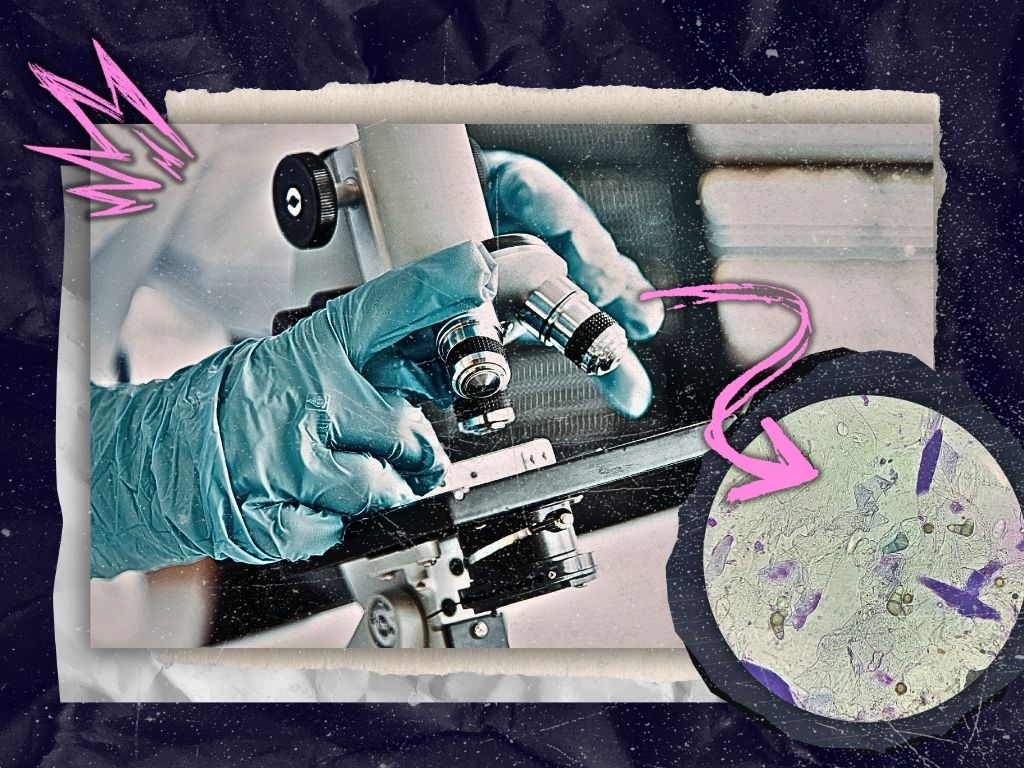
Peering through the microscope with The Host-Parasite Interactions group and their initiatives
By Daniel Rodriguez Barrios, March 25 2026—
Most people do not think about parasites often. When they do, they think of gross things in jars, horror stories from travel medicine or an easy metaphor for a drain on resources. The members of the Host–Parasite Interactions (HPI) group, on the other hand, are positively fascinated by parasites in all forms, and are continuing nearly fourteen years of work at the University of Calgary. The group dates back to 2012, when researchers scattered across different labs formed a training group through the NSERC CREATE program — a funding stream designed to build training environments for graduate students.
Dr. Constance Finney — assistant professor in UCalgary’s Department of Biological Sciences and HPI’s community engagement portfolio lead — spoke to the Gauntlet about HPI’s history and outreach work. She described HPI as a “loose network” based at UCalgary, but extending across Western Canada, with members at the University of Lethbridge, the University of Alberta, the University of Victoria and the University of Manitoba. Across that reach, HPI connects researchers and students and organizes parasite-education events for surrounding communities; with public-facing outreach built and delivered largely by students.
HPI’s events range from public venues (libraries, science centres, community days) to school-based programming and mentorship. Finney pointed to recurring outreach settings — from Alberta Biodiversity Days to programming with places like the Habitat Station and Telus Spark, as well as library events that can turn a public space into a hands-on science booth for an afternoon. Much of that work is coordinated through an outreach committee that meets regularly to plan events and update materials.
The draw is strongest among young people, who love the group’s microscopes, models, games and jars with “really gross stuff that people love to look at.” HPI’s outreach kit ranges from the institutional to the handmade, whether knitted thread or papier-mâché, alongside microscope stations and specimens. Finney described moments where kids get so excited they run off to bring a parent back to the table, insisting they come look through the microscope too, or return for another round of the ongoing activity. The upside of doing this work in public is that the feedback is immediate: you can tell, in real time, when something isn’t landing. In those moments, Finney said, the group is prepared to change things on the fly — to go off-script and work with the room they actually have, rather than the one they planned for.
When the NSERC CREATE funding’s five-year term ended in 2017, HPI did not disappear, but continued informally by pooling nominal membership fees, volunteer time and a community of engaged members. Finney described HPI as operating on modest budgets, working with little and pieced together from what HPI members were willing and able to put in. Student involvement, in particular, is central.
“Most of the work is actually done by students,” said Finney.
Especially in outreach — students plan and staff events, build the hands-on materials and deliver activities in classrooms and public spaces, with faculty providing guidance and administrative support. The group leans on mailing lists, alumni connections and an open-door approach to recruit volunteers, who may not be parasite specialists but can still serve as “enthusiastic ambassador[s] for science.”
In return for this work, HPI does not charge participating schools, aiming to spread access beyond merely the city’s more affluent schools and neighbourhoods. One current initiative is HPI’s Calgary Science Fair Mentorship Program, which works through relationships with the Calgary Youth Science Fair and participating schools. HPI visits schools to run guided sessions where students access scientific instruments and science-based experiences their schools may not otherwise have the time, budgets or equipment to provide. The group has also been expanding its language access, including a pilot francophone version of the mentorship program.
Another initiative, “Minds in Motion,” is a natural sciences summer camp where the group comes once a week to run parasite-themed activities and presentations. These aim to make kids more open to science, building comfort with inquiry, scientific tools and biology in general as something to explore rather than merely memorize.
Finney also noted that parasites are not only a faraway topic — they show up in Calgary’s local ecosystems too.
Beyond in-person events, HPI also produces outreach products — games, children’s books and teaching resources — which it shares for free through a free online repository called Qubes Hub. People around the world download and reuse materials there without needing to purchase or develop them from scratch. Some of those materials are designed so teachers can adapt the language and reading level. For example, by rewriting text elements, the same activity can travel across classrooms and contexts.
“So they’re [parasites] very complex organisms. So they’re like bacteria and viruses have smaller genomes that are relatively few proteins involved there.” noted Finney. “They have a lot of machinery, they’re super complex, they need a long term infection. So they’ve grown, they’ve adapted to make sure that they can stay hidden or fight whatever it is that’s being thrown their way.”
In that sense, HPI’s outreach mirrors the phenomenon it studies: living systems shaped by contact, adaptation and sheer resilience.
“Our directions are as open as the people coming in with new ideas,” said Finney.
For anyone interested in participating in HPI outreach activities, please contact Constance Finney (constance.finney@ucalgary.ca). No parasite experience needed, just lots of enthusiasm for communicating science with the public!