
Queer Romeo and Juliet: A love forbidden twice
By Abeer Bukhari, March 25 2026—
From Feb. 20th to 28th, Sage Theatre Society & The Shakespeare Company put on a rendition of Shakespeare’s classic Romeo and Juliet, tailored for the new age exploration of forbidden love, sexuality and sin. Adapted by Joe Calarco, it entails the fascination of four eager students with the famous tragic play who embark on an emotional journey, exploring their queer identities.
Whilst they act out meaningful scenes that unravel the romance and tragedy of Romeo and Juliet, the students quickly realize just how parallel the acts are to their own lives and internal struggles. Tension comes to a boil when Romeo first hesitates to kiss ‘Juliet’, for that would mean the male student (played by Joel David Taylor) would have to face his sexuality head on in a romantic gesture — and said gesture acts as a queer awakening for the boy playing the girl (played by Brett Dahl).
Director Javier Vilalta notes that the students are “encouraged by the resilience shown by Romeo and Juliet,” and from then on it is an elusive game of desire that is nerve-wracking, yet passionate between each of them. The tension ultimately boils over when the group of friends act out in each scene, inevitably revealing the leads’ feelings for one another. And the forbidden, sinful nature of that very attraction draws parallel to the reveal that Romeo and Juliet, one Montague and other Capulet, could never be.
It is a devastating nod to the fact that forbidden love continues to manifest in modern spaces, and how the forbidden nature of attraction that identifies beyond gender is a suffocation of self-identity. Each actor of the four characters does an astounding job at portraying the sensitivity of a closeted person within a religious institution where femininity, sexuality and desire are strictly frowned upon and deemed sinful. Acting out this play enables the group of friends to explore these themes through passionate monologues, dance and even song. The way a male portrays a female, particularly in terms of mannerism and effeminated voice is an amazing portrayal of the fluidity of gendered experience. And thus when the turmoil stirs each time they must pray and swear against the sins of ‘lust and desire,’ it sets the stage for an inner dilemma that is faced by many marginalized religious members of the LGBTQ community.
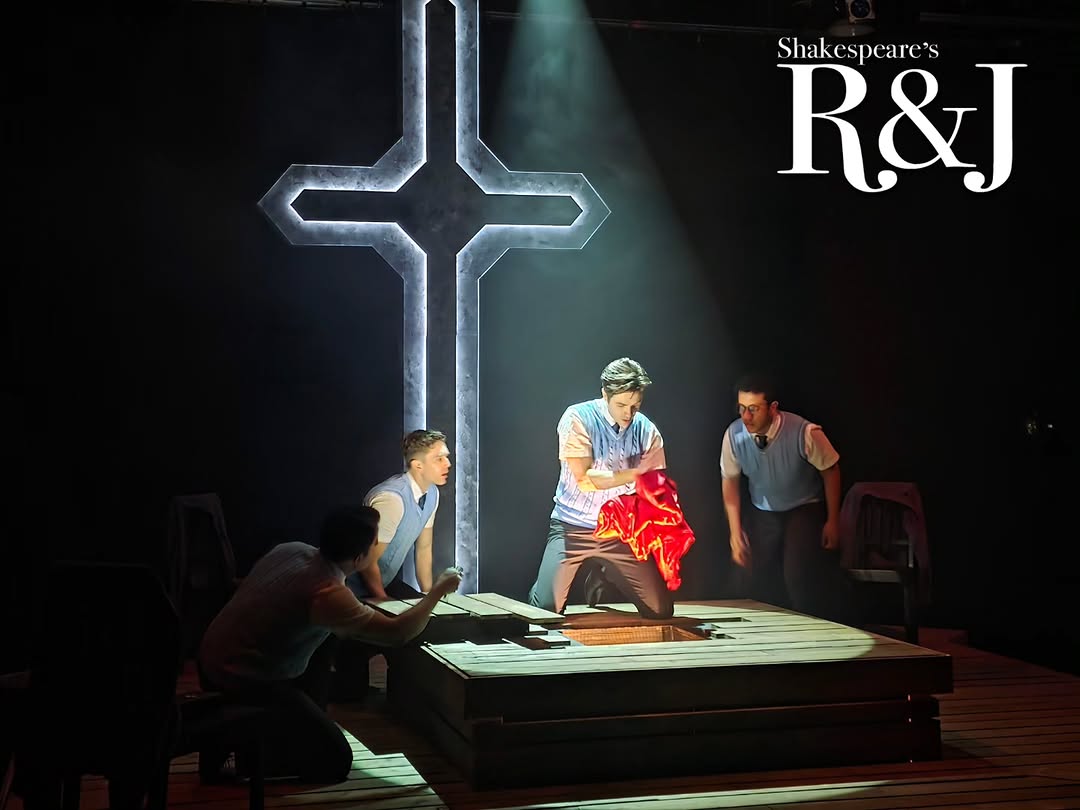
Production on this piece, though minimal, makes good use of a large cross center stage that glows each time the students must call back to religion, and establishes very well the overbearing guilt of a spiritual commitment. I especially appreciate the set design, for its simplicity allows the scenes to carry on fluidly, but also carry the symbol of religion and rules heavily in the background even when there is a pinnacle of queer expression center stage.
The unveiling of the students’ copy of Romeo and Juliet hidden in a compartment paints it as scandalous — something they should not touch that is tucked away and yet they are drawn to it anyways. In this compartment is also a flowing red cloth which they use in abundance to portray different elements of acts throughout the play. Its versatility lets it be showcased as Juliet’s gowns, blood in a gruesome duel, a means to conceal bodies and even showcase sensuality. I find its most excellent use was when ‘Romeo’ and ‘Juliet’ share an intimate and emotional dance, stripping nearly bare and ultimately laying down together in an acceptance of their fears and sexual identities under the red cloth’s draped protection. Paired with the haze of the smoke-screen mist, a truly beautiful intimate atmosphere was created that could only leave the viewer in a state of admirance and resolution.
Though the students act out the rest of the play — including Romeo and Juliet’s broken-hearted suicides — a last-minute twist in this adaption of the tragedy leaves it on quite a different ending note than the regretful close Shakespeare did. In a dampened mood resolving to surrender to their educational and religious rules, the four friends hide away the red cloth and their copy of the play. It is here that ‘Romeo’ draws away from their ritualistic prayer and stands center, engaging in a monologue. He speaks of his dreams and is no longer afraid to accept his desires; his queerness, dragging the red cloth and letting it flow in the wind, holding the copy of their meaningful Shakespearean play and then exiting stage in a beautiful show of breaking free of the rules that governed his fear.
At this last second, we see his ‘Juliet’ that had prior shunned him reaching out a longing hand — and then the act closes. The adaptation ends on the hopeful note that the brave ‘Romeo’ had opened a path for others to follow his acceptance of his queer identity and not be so confined by their fears.
This reimagination of the centuries old tragedy through the theme of queer awakening adds a sort of depth that deeply resonates with the modern audience, since that is the very love that is still culturally or legally forbidden in many parts of the world. Though instead of a dismayed mistimed somber love that dies, the audience is left with a Romeo who is liberated from the rules that bind him, and chooses his love over his fear.