
UCalgary’s Jared Voris and the “Reaper of Death”
By Hannah Caparino, March 26 2026—
The “Reaper of Death” stomps its way to Earth Sciences
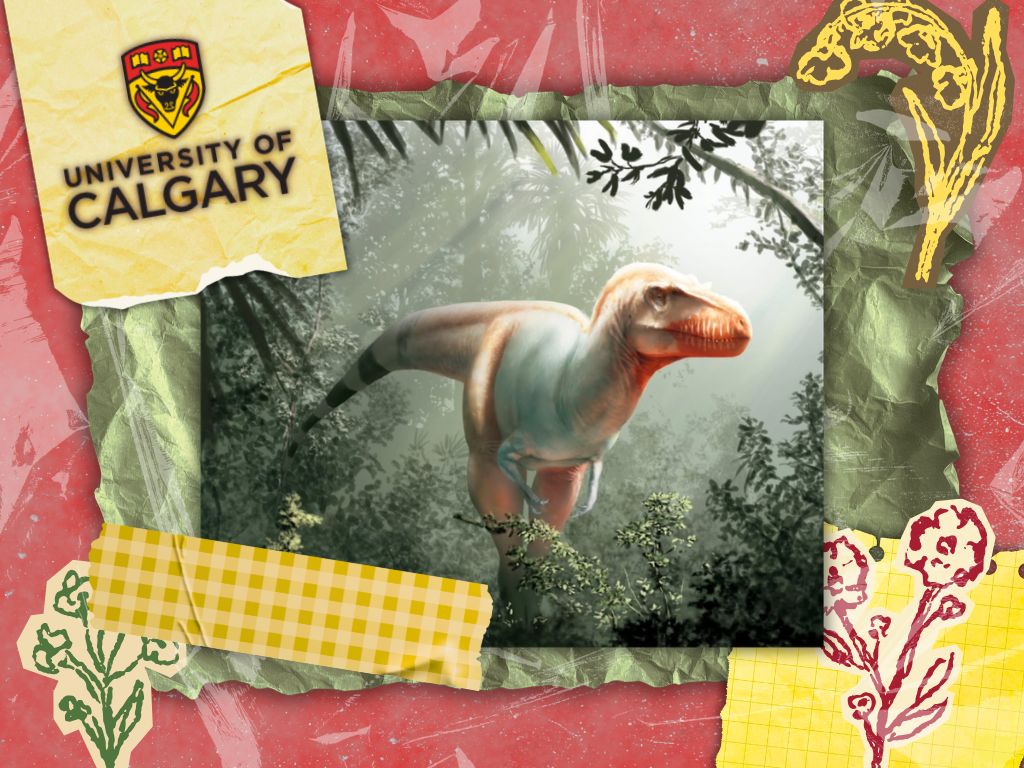
Jared Voris, a PhD student at the University of Calgary discovered a new species of Tyrannosaur. Discovered in the heart of Dinosaur Provincial Park by John and Sandra De Groot and brought to the Royal Tyrrell Museum; Voris spent the last five years analyzing pieces of the Thanotheristes skull to bring it on campus for everyone to see. On Feb 26, Voris and his peers gathered at the Earth Science building to unveil a 3D-printed model of the Thanotheristes also known as the “Reaper of Death.” The “Reaper of Death” exhibit featured an illustrated replication of the Thanatostheristes and a landscape that was completed by Julius Csotonyi, a paleo artist.
At the unveiling, Faculty of Science Dean Dr. Kristin Baetz congratulated Voris’ team and his supervisor, Dr. Darla Zelenitsky. The skull was constructed through CT scans and was digitally reconstructed before creating the model. Before the 3D-printed and reconstructed skull made its way to the University of Calgary, the exhibit was kept under wraps until its official opening this past February. Voris spoke to the Gauntlet about how his PhD and research was centered on the discovery of the Thanotheristes.
“During my master’s program here, we started to realize that this was something completely different,” said Voris. “As time has gone on, and now that we’re here five years later […] we decided that we wanted something to kind of showcase that discovery that was made using University of Calgary resources.”
The Thanaotheristes was originally described to resemble the Daspletosaurus which was commonly found in Alberta. When Voris began to analyze the found specimen, he recognized physical traits that were never before seen which marked the beginning of his new discovery.
“Right off the bat, we knew that this animal, this new species, actually came from a time interval that was two million years older than any of our earliest known specimens of Daspletosaurus.” said Voris, “We started to see things like these really prominent ridges along the outside of the upper jaw, those are things we don’t see in Daspletosaurus. The cheekbone […] was thick and rounded for a rounded orbital margin. […] In Daspletosaurus, that essentially comes to a bladed point.”
When describing the physical comparisons that were being made to other Tyrannosaur species, the jaw ridges and different orbital margin; also known as the animal’s eye cavity, were unique to this skull. What Voris also found about the Thanatostheristes was that it predates common Tyrannosaur species, appearing during a period where the Tyrannosaur was burgeoning on becoming the next apex predator.
“Here in the province of Alberta, […] our dinosaur fossil record extends from right when the dinosaurs died out 66 million years ago, further back in time, all the way to roughly 80 million years of age. So that’s when our fossil record starts to peter off, we don’t have as much preservation potential for the rocks there.” said Voris, “But Thanotheristes comes from that very early point […] around 78 million years of age, or 78 to 79 million years of age.”
The new opening of the “Reaper of Death” exhibit also saw the science faculty becoming more interdisciplinary, with Voris explaining that his study worked with various subjects.
“I’ve essentially kind of worked to bridge the gap between how we understand evolution, and biology with the geological information, our understanding of deep time, how it is that rocks change, or the Earth has changed over time.” said Voris.
Voris explains that the exhibit was made as a result of all faculty of science departments working together to push for a better understanding of our world.
“It shows how important continuing to push the envelope [is] in our understanding of the world.” said Voris, “So I think it’s an indication that there is still so much to learn from the world.”
Students can view the exhibit on the first floor in the Earth Science building. For more information about the exhibit, click here.