
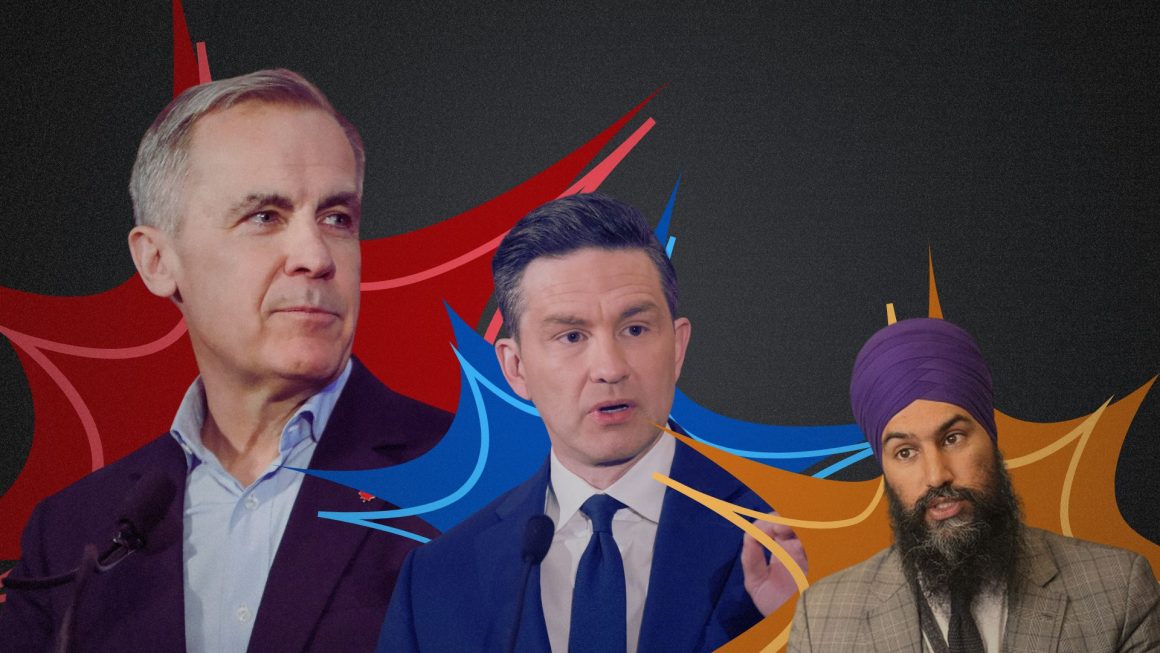
The man, the boy and the third wheel
By Josie Simon, April 2 2025—
Mark Carney is the man Canada needs. Pierre Poilievre is the boy who isn’t ready. Jagmeet Singh is the third wheel nobody asked for. On Apr. 28, Canadians will choose between these three leaders, and the stakes couldn’t be higher with Trump threatening our sovereignty and an economic crisis looming.
Mark Carney: The man
Mark Carney brings practical experience and strong educational credentials. He successfully navigated Canada through the 2008 financial crisis as Bank of Canada Governor, with our economy outperforming all G7 nations. He became the first non-British Governor of the Bank of England in more than 300 years, skillfully managing Brexit’s economic fallout. His Harvard and Oxford education culminated in a PhD in Economics.
Carney spent 13 years gaining experience at Goldman Sachs before entering public service. As Chair of the Financial Stability Board from 2011 to 2018, he directly engaged with Trump during his first term. In 2019, he became the UN Special Envoy for Climate Action and Finance.
Since becoming Prime Minister in March, Carney has taken decisive action. He immediately scrapped the consumer carbon tax and secured international support in France and Britain. He invested $6 billion in a border radar system and $420 million in Arctic sovereignty protection, demonstrating a serious commitment to defending Canadian interests.
Carney’s biggest challenges throughout the election have been distancing himself from Justin Trudeau’s unpopular legacy and defending his corporate background at Brookfield against Conservative attacks portraying him as an out-of-touch elite. Despite these hurdles, polling suggests Canadians still strongly favour the Liberal Party under Mark Carney’s leadership.
Pierre Poilievre: The boy
Pierre Poilievre lacks the basic qualifications to lead Canada. He holds only a Bachelor’s degree from the University of Calgary, which he finished in 2008 – four years after already sitting in Parliament. He has zero formal education in economics or finance.
His work history exposes even bigger gaps. Poilievre has never worked outside politics. Elected at 25, his entire career consists of partisan politics. He has never run a business, never met a payroll, never faced market competition and never implemented the economic theories he confidently preaches.
Poilievre experienced the 2008 financial crisis as a junior backbencher. He has zero experience in international finance, central banking or economic diplomacy. His economic knowledge comes solely from political talking points, not from experience or serious study.
Self-described “friends” of India’s ruling BJP party donated thousands to Poilievre’s Conservative leadership campaign, raising concerns amid strained Canada-India relations. When questioned, Poilievre defended himself by stating he received 37,000 separate donations and lacked “the capacity to do CSIS background checks” on every contributor.
Poilievre built his reputation by saying, “Canada is broken.” Now facing a genuine crisis with Trump threatening Canadian sovereignty, his Trump-like rhetoric has become his greatest liability. Elon Musk has endorsed him, which raises serious questions about Poilievre’s independence and ability to stand up for Canadian interests against American pressure.
Jagmeet Singh: The third wheel
Jagmeet Singh has impressive credentials. He earned a biology degree from Western University and a law degree from Osgoode Hall Law School. Singh worked as a criminal defence lawyer for five years, showing his strong advocacy skills and commitment to justice. However, he has no formal training in economics or finances.
Singh entered politics as an Ontario Provincial Parliament (MPP) member in 2011 before becoming federal NDP leader in 2017. Unlike Carney, he has never held executive office with economic responsibility. His supply-and-confidence agreement with Trudeau allowed him to influence policy but not direct it.
Singh now faces a stark reality: his party is collapsing as progressive voters strategically back Carney. NDP support has plummeted to 8.5 per cent nationally, while Singh trails badly in his own riding with only 17 per cent support versus 68 per cent for his Liberal opponent.
Singh’s campaign now struggles as he faces criticism for taking funds from local ridings to support his own campaign. Despite social media popularity, he has not translated online support into electoral victories, exposing serious leadership weaknesses.
The only rational choice
Poilievre is dangerously unqualified. Period. A career politician with zero real-world experience, he offers empty slogans and simplistic solutions to complex problems.
As for Singh? A vote for the NDP is effectively a vote for Poilievre. The polls confirm that Singh most likely won’t even win his own riding. This political reality makes strategic voting not just smart but necessary.
Carney isn’t perfect—no politician is. But he’s the only one who offers extensive experience in protecting the nation, drawing from his global economic expertise at the Bank of Canada and Bank of England.
The choice is clear: Vote Carney on Apr. 28.
This article is a part of our Opinions section and does not necessarily reflect the views of the Gauntlet editorial board.