
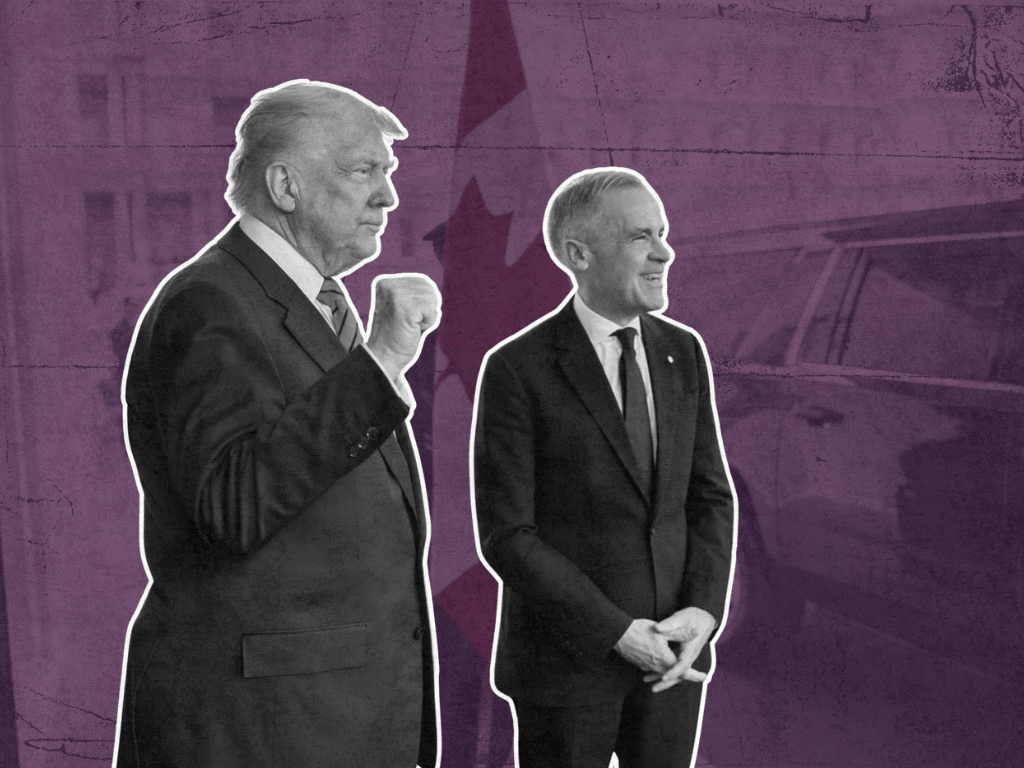
Carney’s trip to Washington: the state of Canada-U.S. trade
By Alexander Howey, November 15 2025‚
On Oct. 8th, Prime Minister Mark Carney departed Washington empty-handed after his second formal meeting with U.S. President Donald Trump.
While Carney spent last Spring campaigning himself as the person best equipped to deal with current trade disputes with the United States, he left the White House once more with no deal in hand to lift tariffs on Canadian goods.
A statement on the Prime Minister’s website indicated that in the meeting, both leaders “identified opportunities for material progress in trade in steel, aluminum, and energy,” in addition to discussing “opportunities to cooperate in defence and focused on their shared efforts to bolster Arctic security.”
“Canada currently has the best trade agreement of any U.S. trading partner, with 85 per cent of Canada-U.S. trade now tariff-free, and our cooperation is further improving border security,” the statement reads.
The Gauntlet interviewed UCalgary Professor Dr. Kim-Lee Tuxhorn, who has research specialties in how states bargain over international economic arrangements.
“What we’re kind of observing now with the U.S and the current administration, is that there is a serious departure from the last roughly 80 years of international trade and understanding of trade cooperation that we’ve had,” Tuxhorn explained.
“Carney is probably doing as well as anyone else,” Tuxhorn said, when asked about how Carney has responded to this major shift into protectionist trade policy. “Most of the G7 leaders are scrambling at the moment, so I wouldn’t put Carney above or below the rest of his peers in that way.”
In an attempt to appease the American president, Carney has dropped many of Ottawa’s retaliatory tariffs, as well as introducing border security legislation and pausing Canada’s digital services tax.
The Prime Minister has indicated that his government is not considering hitting American goods with more retaliatory tariffs, because there are signs that bilateral talks are headed in the right direction. These talks have been centered on steel, aluminum and energy sectors, including the possible revival of the Keystone XL pipeline.
“Encouraging folks in the United States to pressure Trump to pull back its tariffs, that is essentially what a retaliatory tariff is intended to do,” Tuxhorn explained. “It still hurts consumers.”
“We kind of know from other countries and examples that this has not been effective,” Tuxhorn continued, listing China as an example.
Trump has stated that an entirely tariff-free deal with Canada is not in the cards, but has indicated he is open to renegotiating the Canada-U.S.-Mexico Agreement (CUSMA).
In August, Trump boosted tariffs on Canada to 35 per cent, but this doesn’t apply to goods compliant with CUSMA, which accounts for about 95 per cent of exports.
Talks to update CUSMA are set to start next year, although Carney has indicated this won’t resolve all outstanding issues regarding Canada-U.S. trade.
“These are seismic shifts that we’re seeing right now,” Tuxhorn explained. “Even if you have a different party in office in the United States, it’s not going to just be a 180 on that policy.”
The Liberal government is set to table a federal budget on Nov. 4th, which will include details on Canada’s defence and infrastructure spending commitments.
In a primetime address to students at the University of Ottawa on Oct. 22nd, Carney vowed to double non-U.S. exports over the next decade, and boost domestic infrastructure and investment in the upcoming budget.
The Prime Minister acknowledged that the federal government has been spending more than the economy has been growing over the last decade, and that the upcoming budget will outline strategies to reduce government spending and streamline services.
“We do see a lot of countries investing in and focussing more on industrial policy, that is picking specific industries to support and generate economic growth,” Tuxhorn explained. “This is somewhat of a turnaway from how we think about open capitalist iberal economies.”
Carney’s speech followed a report from Desjardins Group that estimates that the upcoming federal budget deficit could be the highest in 30 years.
“I think most models are suggesting that we’re going to see a slump,” Tuxhorn explained. “Canada right now has a lot of hard decisions to make going forward.”
On Oct. 26th, Trump announced that he would raise U.S. tariffs on Canada by 10 per cent in retaliation for an anti-tariff advertisement from the Ontario government, prompting Premier Doug Ford to suspend his U.S. ad campaign. The ad used an excerpt from a 1987 speech from Ronald Reagan, in which he said that “trade barriers hurt every American worker.”
It is currently not clear what these tariff increases will effect, or when they’ll come into place.
Tags: Canada-U.S. trade, Political Economy, Dr. Kim-Lee Tuxhorn, Federal Budget, Mark Carney, Donald Trump