
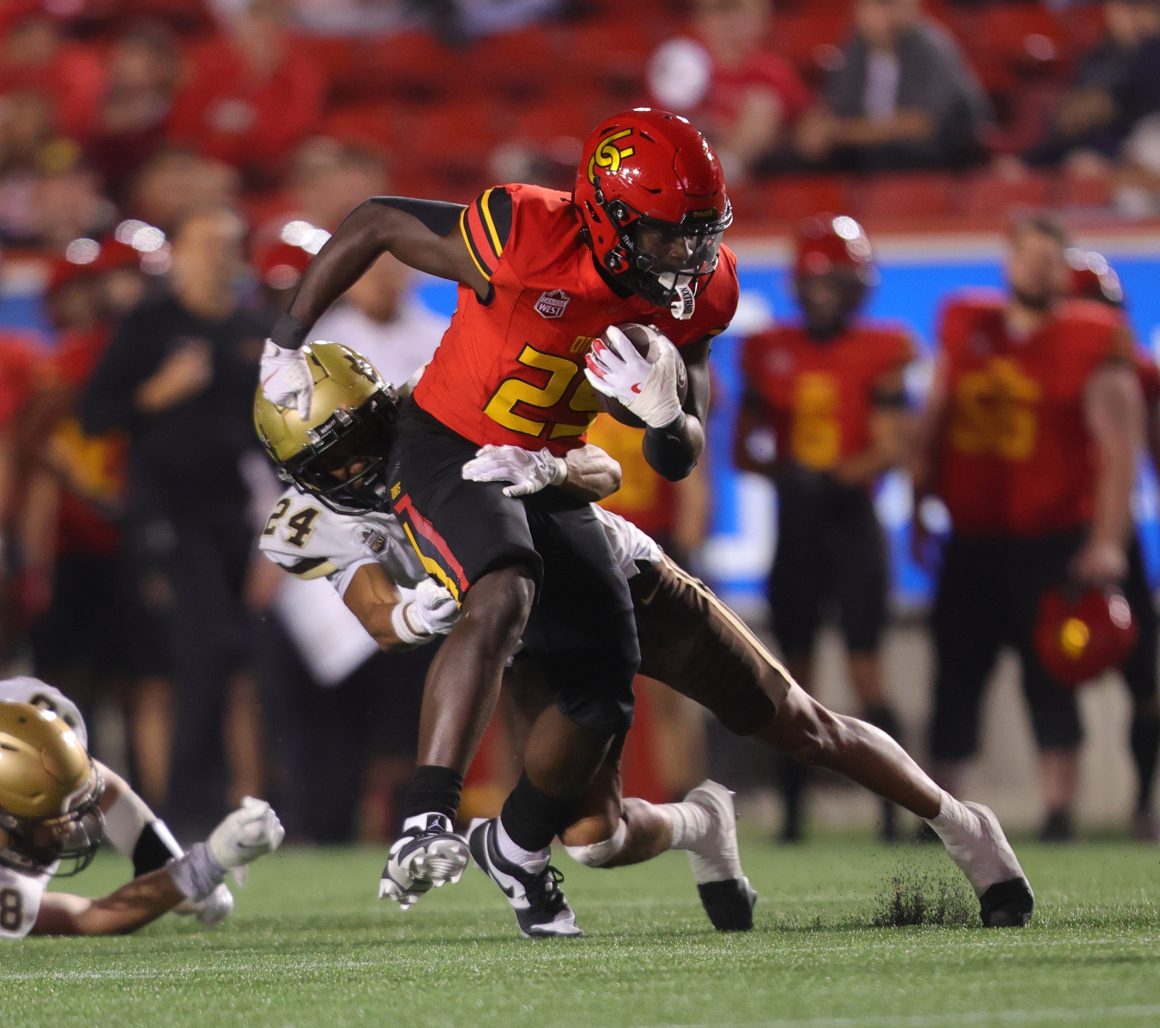
Rising to the Occasion: Eri Olarubofin’s story from Div III football to first-year starter
By Maggie Hsu, December 17 2025—
When Eri Olarubofin committed to the University of Calgary Dinos nearly a year ago, he didn’t imagine that by mid-season, he would be running out of the McMahon Stadium tunnel as the team’s starting running back. For a player whose football journey began almost by accident, the rise feels sudden — but never unearned.
Immigrating to Canada from Nigeria as a child who loved to move and be active, young Eri, who only ever played ‘real’ football, also known as soccer, saw sports as an opportunity to try something new. He never thought it would lead to anything larger, let alone a promising football career — the North American version.
“I only really started playing sports when I came to Canada,” he recalled. “It was mainly soccer back home. Then I broke my arm playing rugby in Grade 7, and that’s when I switched to football. I didn’t want to go back to rugby after that.”
Football began almost by accident. Running back came even later. He started as a linebacker and defensive end before curiosity pulled him to the offensive backfield. By Grade 8, he was fully committed to the position.
“Once I started watching more football, I knew I wanted to try running back. I’ve been playing it ever since,” said Olarubofin.
From overlooked to overachieving
Before he was a Dino, he was a student at Lord Beaverbrook High School in Southwest Calgary, a program widely assumed — often unfairly — to be an afterthought in Calgary’s football landscape, which has been perennially dominated by St. Francis, Bishop O’Byrne or Bowness. Division III isn’t typically where university starters are supposed to come from. But that’s where standings and score sheets don’t always reflect the product on the field.
“I heard the team wasn’t good, but I was really surprised,” he said. “People my age had played a lot of football outside school. The players were good. The coaches were good.”
Good enough, in fact, to push Beaverbrook into the city finals in his Grade 10 year. And then again in Grade 11, when they went undefeated in the regular season. By Grade 12, the school earned promotion to Division II. He only missed their playoff run due to a dislocated shoulder and a late-season foot injury — something he still carries with a bit of guilt.
“I felt like I let the team down,” he admitted. “But honestly, that whole experience showed me people underestimate Division III. The talent was there.”
It’s hard to say whether Olarubofin was the X factor for Beaverbrook’s success. Shifting tides of high school football reflect university sports, where turnover has a large impact on how seasons play out. And when you add on the factor of schools collecting students based on zones and communities, you could say Olarubofin was just fated to be on this team that proved the city and doubters wrong.
Still, coming out of a DIII program meant fewer eyes on him. Scholarships weren’t guaranteed. Recruiting conversations weren’t nonstop. And yet, with the limited spaces on U SPORTS football programs across the country, the University of Calgary was interested early — and consistently. He was also speaking with UBC, Alberta and Toronto, but being close to home and family struck a chord.
“I always wanted to stay home, and the Dinos got to me first. I liked the coaches, and I liked the culture they were building,” said Olarubofin.
Thrown into the fire
That culture would soon be tested.
The Dinos entered 2025 with one of the largest rookie classes in the country — over 50 incoming players — and an unusually inexperienced running back room. The lone veteran was Matthieu Clarke, the clear starter and mentor figure for the fresh faces behind him.
But football has a way of sticking a rod in the spokes of what should be a well-operated machine.
When Clarke suffered a mid-season injury in the opening weeks of the season, everything changed.
“It was a terrible situation. I felt bad for him — he was having such a great year,” Olarubofin reflected.
But then came the moment every backup both fears and dreams of:
“I knew this was an opportunity. I wanted to show I could be the next guy, that they could trust me,” he said.
And he answered the call immediately. Stepping in and contributing immediately, bringing a burst of energy, physicality and fearlessness that surprised opponents — but not his coaches.
He credits much of that readiness to running backs coach Gino DiVincentis, whose demanding style he now sees as foundational.
“He knows how to get the best out of us. Sometimes it feels like a lot, but that’s why I was able to perform the way I did. And watching Matthieu every day taught me so much,” said Olarubofin.
Built by underdogs
The 2025-26 Dinos’ season has been defined by catching their veteran-heavy opponents off guard. With tight games and an unrelenting tenacity to force late comebacks, Calgary, young as it is, has become a team that refuses to go away.
“We’re always a second-half team,” he said, half laughing, half frustrated. “If we could play our football for the full 60 minutes, I really think we’d be a top team.”
Part of that belief comes from the vets — players with four or five years of discipline, film study and early-morning workouts behind them.
“What I’ve learned from the vets is the love they have for each other,” he says. “Fighting for your brothers, showing up even when you’re sore… the discipline. If you don’t love the game, you can’t do this.”
The Dinos’ season ended outside the playoff picture for the fifth straight year, and a late injury kept Olarubofin out of Rookie of the Year contention. But his story — one of stepping up long before he expected to, and proving he belonged every time he touched the ball — is a microcosm of where the program is headed.
A young roster, hardened by growing pains. A locker room full of players who no longer shrink at expectations. A running back who never asked to be the face of a rebuild, but played like one when circumstances demanded it.
The Calgary Dinos may not have been circled as a threat on anyone’s schedule this year. Next season, that won’t be the case. Not after opponents saw what athletes like Olarubofin — a Division III kid who refused to be defined by his starting point — can do on a national stage.