
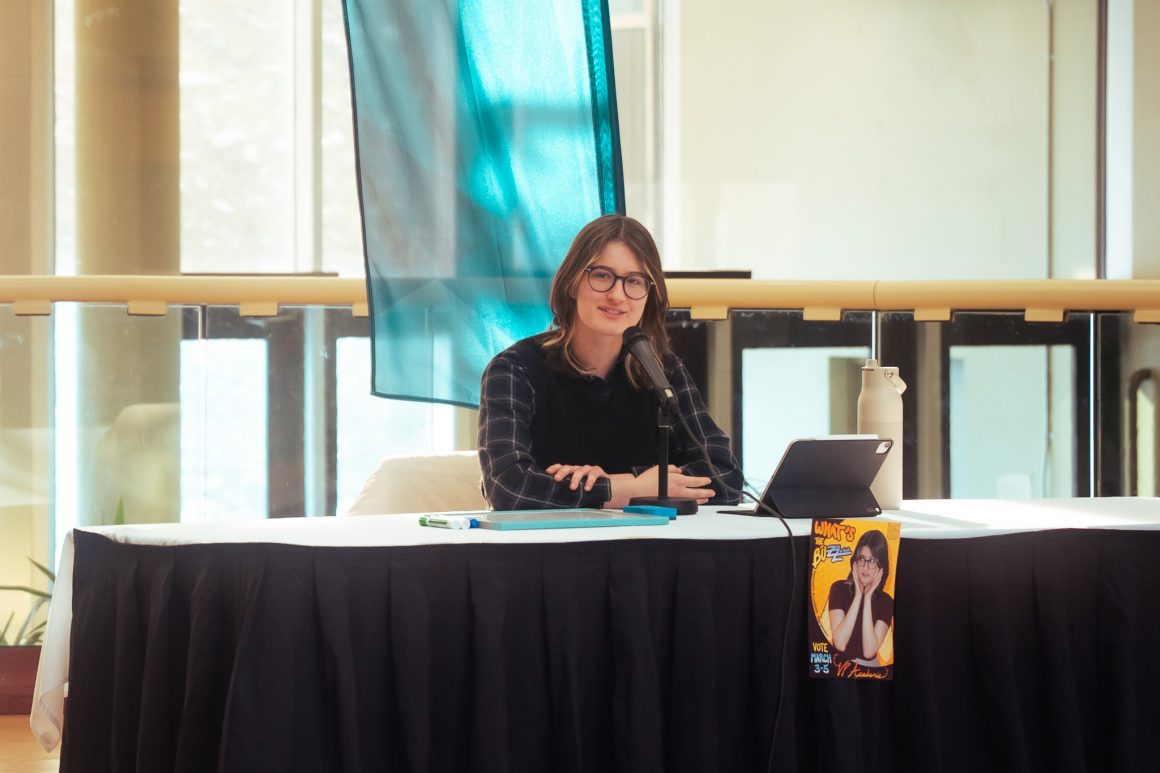
Uncontested VP Academic candidate Zoe Zeritsch talks about academics and student wellbeing at SU forum
By Elaine Liang, March 2 2026—
To kick off the 2026 Students’ Union (SU) General Election forums, uncontested Vice President Academic (VPA) candidate Zoe Zeritsch presented her goals in prioritizing students’ academics and wellbeing.
The three pillars of Zeritsch’s platform are improving learning environments, tackling program transparency and improving access to experiential learning opportunities.
Zertisch’s platform is centered around her belief that students should be prioritizing their mental and physical wellbeing.
“The stigma going around that university is going to be the most difficult thing that you guys will ever have to do in your life is something that should not be normalized,” said Zeritsch.
She believes that the biggest academic issue students currently face is the disregard for mental and physical health at the university.
“The rampant disregard for mental and physical health, as well as the lack of clarity of programs causing unneeded stress on students, really needs to be addressed,” said Zeritsch. “To do that, I feel like students need to really be consulted on these issues…everybody has a different program, everyone has different requirements and I want to make sure all of them are addressed…whether that be advocating in committees, making sure students feel comfortable and safe in their degree progression, I want to make sure everyone feels cared and tended for.”
A key point of Zeritsch’s platform is having flexible deadlines for assignments and wellness days that students can use at their discretion. She believes that this will allow students to take breaks, avoid overworking themselves and prioritize their mental health. Zeritsch did not outline a clear plan for how she will achieve this.
When asked about what she thinks is the most important committee that the VPA sits on, Zeritsch pointed to the General Faculties Council (GFC).
“[The GFC seat] allows [the VPA] a meeting to sit down with both the President and higher executives at the university,” said Zeritsch. “[The VPA] gets to talk to the President and present student issues…and you get to actually let them know what is going on at the student body level,” said Zeritsch.
Another key goal of Zeritsch’s platform is to pressure the university to establish an AI usage policy that will clarify when it should be used in courses.
“The University of Calgary is one of the only universities that does not have a currently established AI policy. This means AI can rampantly be used for class work, course work, graded material and even final exams” said Zeritsch. “My personal opinion is that AI and AI-related course assessments should be staying out of graded material. AI is a very, very important tool for learning [and] for helping with course assessments, but it definitely should not be in place of a class discussion…regardless of my viewpoint, AI needs to be policied on campus. Although I will not be the one making the policy, I will do my best to pressure the university that we need to establish an AI policy.”
When addressing the changes that Arts students are facing in the renewal process, Zeritsch emphasized the role of the VPA to be a “listener.”
“I want to ensure that students…know that the VPA has their back,” said Zeritsch. “There’s going to be a lot of changes and that’s not going to be something that you can change…making sure that your rights are being protected, making sure that you’re able to get into your classes and…needing clarity revolving around the changes…you need to come to the VPA and we can explain it to you and hopefully help you.”
To tackle the issues of course availability, class accessibility and degree progression, Zertisch is aiming to alter seat allocation and push for increased opportunities, including hybrid learning.
“Hybrid learning is such a great opportunity for students to be in a class. On top of that, with open access resources, I feel like it could be a very good alternative and an option for students to help to complete their degree…I feel as though being in an online class would be a lot better than having to take an extra year because you weren’t able to get into the class that you were needing to get into,” said Zeritsch.
Zeritsch stressed that every student issue deserves her time as VPA, if elected.
“I’m not the type to back down from a challenge,” said Zeritsch. “Although some issues are “more important” than others, I think that all issues deserve some time to consider. Using the method of majority rules where you focus on the issues that are impacting the most amount of students…doesn’t help the students with, say, a smaller faculty that is slowly burning to the ground.”
“I feel like there will be some issues that I’ll have to prioritize over others, like the Arts faculty, but I want to make sure that students, especially in smaller faculties and smaller programs…know that they are heard for and know that even if I can’t take care of it, I’ll find somebody who can,” said Zeritsch.
“I care about you guys. I’m a student — a student that cares,” said Zertisch. “I’ve seen people in the school be almost decimated by their programs, and it’s really tough to see…if I do get elected, I’m going to fight so hard for student issues.”
Voting for the 2026 SU General Election and the Mac Hall Redevelopment Fund referendum question takes place from March 3-5 through the myUofC Student Centre.
In-person polling stations in Information and Communications Technology (ICT), MacEwan Student Centre and the TFDL foyer will be available from 10 a.m. to 4 p.m. on voting days. All UofC undergraduates registered in the Winter 2026 term are eligible to vote.