
How many stories remain untold?: Calgary Opera’s tragic performance of Madama Butterfly
By Mia Gilje, November 5 2025—
Warning: This article contains spoilers and mentions of sensitive topics
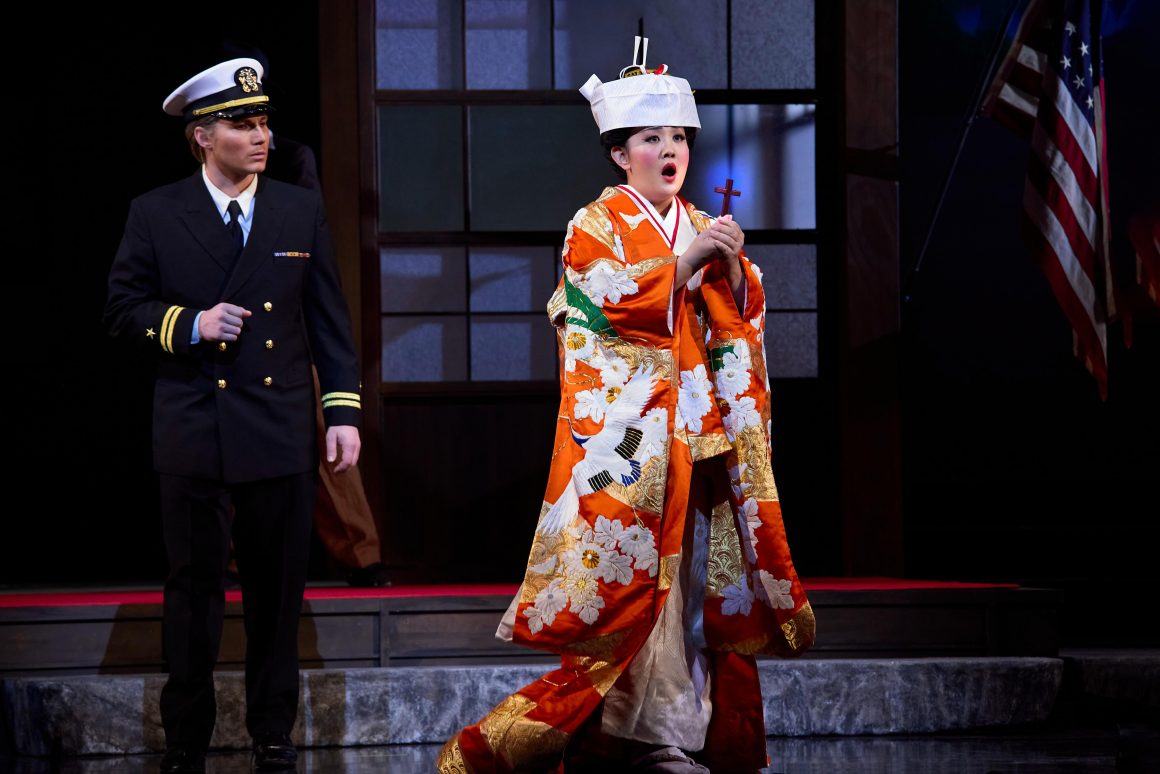
On Nov. 1, 2 and 7, Calgary Opera presents Madama Butterfly — a beautiful tragedy encapsulating one of the many, but all too common grim aftermaths of World War II.
Giacomo Puccini, the composer for Butterfly, worked through many revisions of this Opera. The original 1904 premier and the several iterations to follow received heavy backlash and contained hurtful depictions of Japanese culture — and more specifically, Japanese women.
Mo Zhou, the stage director for Calgary Opera’s performance of Butterfly, wanted to revisit this tragic tale and revise the misrepresentation. To do so, she pushed forward the setting of the story by 40 years, changing the plot to centre around the many Japanese War Brides from post-World War II Japan. Even with maintaining the original libretto and score, this slight change along with an important empathic perspective brings a new light to this story.
The plot follows 15-year-old Cio-Cio-San, “Butterfly,” played by Yasko Sato, and her marriage with the U.S. Navy Lieutenant Benjamin Franklin Pinkerton, played by Matthew White.
Sato’s performance perfectly encapsulated Butterfly’s unfaltering naivety. This young, under-aged girl has fallen head over heels for the concept of love and marriage, she will do anything to please her newly pronounced husband. Even showing her dedication to the United States through praising the flag and abandoning her Buddhist religion for Christianity. Unfortunately, this devotion is unrequited.
Following the end of World War II, thousands of interracial marriages between American soliders and Japense women were formed. Many of these women married and immigrated to the United States in hopes of a better life.
Pinkerton represents the reality of how many of these American husbands viewed their overseas marriages — disposable and temporary. Like the story of Butterfly, other women were abandoned in Japan, often with biracial children they had to raise alone. Even before meeting Butterfly, Pinkerton shares his plans to abandon her once he can return to the U.S. and marry a “real American wife.”
The vocals throughout the show were jaw-dropping and necessary for the emotional impact of this narrative. Nina Yoshida Nelsen who plays Suzuki, Butterfly’s maid, was by far one of my favourite vocalists throughout the show. The moment she began singing during the opening number, I was blown away by the power and control in her singing.
The harmonies within the ensemble were angelic and expertly balanced. As a regular theatre-goer, I have not witnessed a live musical performance that meets the sheer mastery of this cast.
While the set design was nothing short of gorgeous, what truly made the stage come to life was the lighting. The lighting designer Marie Yokoyama and assistant lighting designer Cassie Holms, who is a University of Calgary alumni, deserves a moment of mention. The subtle colour changes within the sky’s lighting excellently portrays the show’s motif of passing time and changing seasons. For a moment, the audience could suspend belief and imagine witnessing the sun set and rise repeatedly within a three-hour show.
After a 25-minute intermission, Act-II began, where the tragedy that is Butterfly’s story comes to the forefront. Six years have now passed since Act I, during which Pinkerton has been living in the United States, leaving Butterfly to patiently anticipate his return.
Everyone in her life tries to get Butterfly to realise that once an overseas husband leaves, he does not return. But her unrelenting naivety and hope does not let Butterfly lose faith.
Finally, after years of no sign of return, Pinkerton’s ship docks at the port — setting up the most effective and impactful moment within the show. Just moments before Pinkerton’s arrival is announced, young-actor Nela Pilecki walks on to stage, playing Sorrow, Butterfly and Pinkerton’s son.
This scene is a gut-wretching reveal that Butterfly was not only abandoned as a wife, but as a teenage-mother. Sorrow was born without Pinkerton’s knowing, further emphasising just how long Butterfly has been left to wait.
Butterfly, Suzuki and Sorrow sat in their home patiently awaiting the Lieutenant to return from his ship.
As the three patiently waited, life on stage froze. No one sang, and other than a gradual drift into sleep, no movement occurred. The lighting shifted from evening, to night, to morning, subtly but clearly demonstrating the hours of waiting without having to express the passing time verbally.
This forced moment of stillness does not just encapsulate that singular moment of patience – it puts the audience into Butterfly’s shoes, even if just for a few minutes, of years of painful and unyielding waiting for a love that was never meant to be.
In the end, this commitment did not serve any benefit. It is revealed that Pinkerton found his “real American wife” and has returned to Japan solely to take Sorrow and raise him in the United States.
Reality-stricken and grief-filled, Butterfly commits one final act, an act that seems to be the only decision fully within her control, something that was unseen throughout the entire show. She dresses in the kimono she was married in, raises a knife above her heart and takes her life. Even if it’s to end it, Butterfly’s fate was finally in her own hands.
As the performance concludes, the audience is asked to reflect on just how many women and children were abandoned and forgotten during this era. Cio-Cio-San’s story is one potential out of the approximately 45,000 Japanese women who married American GI’s. So, just how many stories remain untold?
For more information and tickets, visit Madama Butterfly on the Calgary Opera website.