
Old myths, new visions: Alberta Ballet’s Nijinsky
By Anna Maxwell, November 27 2025—
Earlier this year at Calgary’s Southern Alberta Jubilee Auditorium, Alberta Ballet’s Nijinsky paid bold tribute to one of ballet’s legendary figures. The production, named after dance icon Vaslav Nijinsky, offers a new take on his most famous works. It is not a traditional narrative ballet, but a mixed program of four short pieces inspired by Nijinsky’s Afternoon of a Faun, Petrushka, Le Spectre de la Rose and The Firebird — all reimagined by an all-female lineup of Canadian choreographers. This concept alone is noteworthy, as choreographer Racheal Prince observed in an interview with the Gauntlet before the show.
“To allow four female choreographers to have their take on this is very progressive, considering these classics were created through predominantly male perspectives,” she said.
Denise Clarke’s Afternoon of a Faun opened the show on a playful yet poignant note. In Nijinsky’s 1912 original, a mythical faun’s encounter with nymphs ends in an erotic and scandalous reverie. In Clarke’s modern reimagining, a Poet lounges on a staircase reading Mallarmé’s poem, when a mysterious Woman (a spirit of the theatre) and her friends begin to dance. The Poet is drawn into their world, but his attention strays to one of the Woman’s friends. In a deliberate update of the original’s symbolism, the Woman doesn’t collapse in despair at this betrayal; instead, she quietly walks away, leaving the Poet behind. Clarke’s choreography here was whimsical and intimate, set to Debussy’s Prélude à l’après-midi d’un faune. The final image of the Woman confidently exiting imparted a modern sense of female agency. While this reinterpretation differentiated from the original ballet’s half-man, half-beast protagonist, it offered a relatable commentary on contemporary relationships and independence.
Next followed Alyssas Martins’ take on Petrushka. Martin undertook perhaps the most radical departure from the source material. The original Petrushka (1911) tells a tragic tale of three puppets in a love triangle, ending with Petrushka’s heartbreak and ghostly death. In Martin’s hands, Petrushka became a psychological experience. Her Petrushka “woke up with a brain” and spiralled chaotically through newfound emotions. On stage, this translated into a kinetic dreamscape. Dancers embodied Petrushka’s inner Demon and Darling, seemingly manifestations of despair and love, chasing her through shifting scenes of dreams and forests.
The choreography matched Igor Stravinsky’s frenetic score with wild and abstract angular movements. Martin’s rendition builds to a dramatic climax where Petrushka seemingly destroys her demons and herself, leaving behind glittering bits of her soul as a reminder that one cannot outrun one’s own mind. The performance was haunting and visually striking, though only loosely connected to the source material’s plot. For those familiar with the original, this self-destruction metaphor may have felt like a completely different story. Intriguing, but also somewhat lacking in emotional payoff compared to the tragedy of the classic.
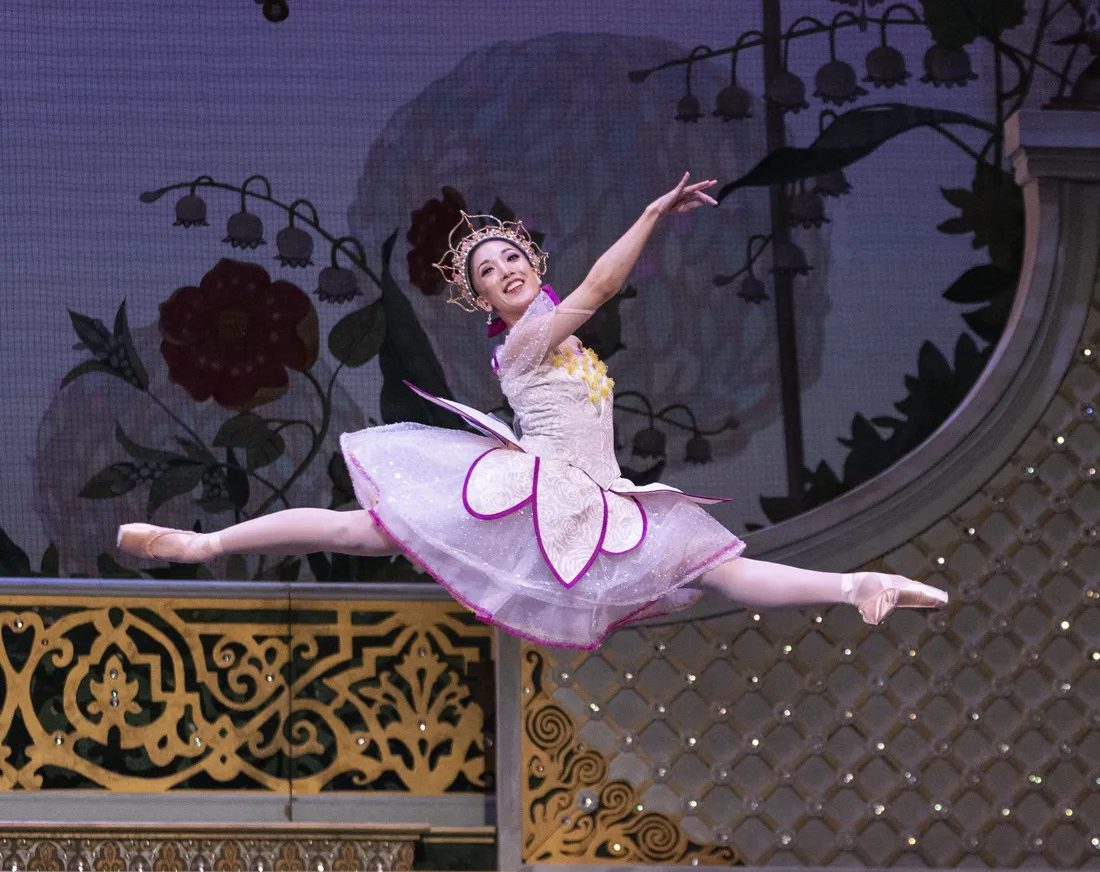
In contrast, Racheal Prince’s Le Spectre de la Rose struck a beautiful balance between homage and innovation. The piece drew inspiration from the famous 1911 ballet in which a young girl dreams of dancing with the Spirit of a Rose (a role made legendary by Nijinsky in a flower-petal costume). Prince’s version begins similarly — a girl drifting to sleep after a ball — but her dream quickly blossoms into something new. Instead of a simple pas de deux, Prince introduced nine dancers as rose spirits, transforming the stage into a living and whirling garden. The male dancers, clad in knee-length skirts covered in roses, are an ode to Nijinsky’s androgynous attire; they moved in harmony around the soloing “young woman” at the center. Each dancer seemed to embody an aspect of the flower’s essence, effectively turning the dream into an exploration of the girl’s inner world. The result was beautiful. Set to the waltz music of Carl Maria von Weber, Spectre retained the ethereal emotions of the source material while adding layers of contemporary perspective.
Finally, the program closed with Kirsten Wicklund’s take on The Firebird. If Martin’s Petrushka was a radical shift, Wicklund’s Firebird was a transformation. The classic Firebird is a Russian fairy tale ballet about a prince, a magical firebird, an evil sorcerer and the triumph of love. Wicklund discarded the literal narrative entirely. Her piece was described as an ode to the art’s power of renewal. Instead of telling a story, the choreography embodied themes of transformation, resilience and rebirth. Dancers flew across onto the stage, their movements at times animalistic and elegant, hinting at the dual nature of the Firebird, without explicitly portraying it. The staging and lighting painted the stage in flickers of red and gold, as if we were inside a phoenix’s flame. The piece was visceral and free-form. As a contemporary dance creation, it was thrilling and avant-garde. However, those expecting the familiar tale might have felt disconnected from the piece itself. Yet, taken on its own terms, Wicklund’s Firebird captivated through the raw emotion of the performers.
Overall, Nijinsky proved to be a very rewarding experience — a bold experiment that showcases the Alberta Ballet’s versatility and vision. The production delivers on its promise to celebrate Nijinsky’s legacy with fresh eyes. In this case, four female choreographers, each with a distinctive voice, pay homage to classical masterpieces while transforming them into something new. The result is a vibrant conversation between past and present. Despite a few moments where the reimagining may have overshadowed the original stories’ clarity, the evening remained unique and thought-provoking. For ballet enthusiasts and newcomers alike, Nijinsky was a celebration of dance history and creative possibility, all in one captivating performance.