
Oil paintings on the Western Front: Munnings — The War Years
By Matthew Johnson, January 28 2026—
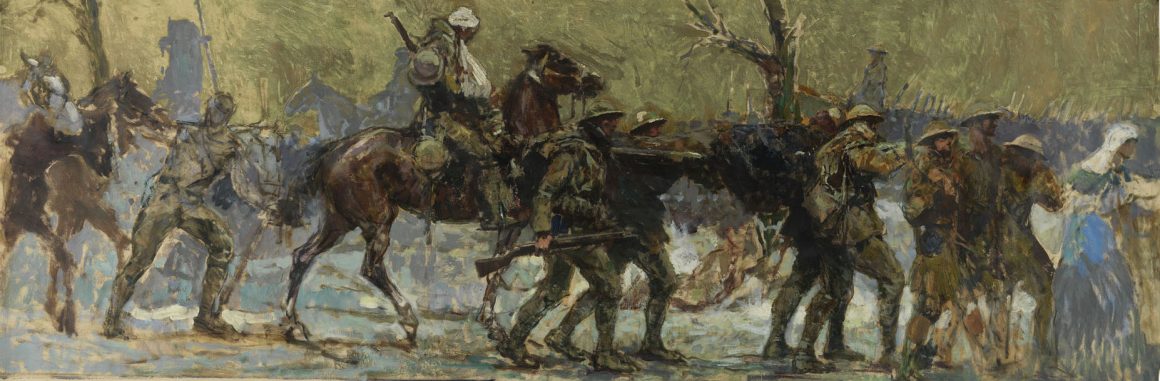
From Sept. 18th to Dec. 6th, 2025, the Nickle Gallery hosted “The Western Front: The War Years”, an exhibition that was free to the public and was displaying the work of Sir Alfred Munnings, the Newlyn School artist known for his paintings of horses during the First World War.
The War Years is a part of a travelling exhibition developed by the Canadian War Museum in Ottawa, in partnership with the Munnings Art Museum and The Beaverbrook Canadian Foundation.
Munnings, who was eager to join the war effort was unable to do so, due to an injury caused when he was younger. While saving a puppy, a thorn pierced his right eye causing irreversible damage and losing complete sight.
Munnings in his second attempt at enlistment saw him tending for horses in England that would eventually end up on the front lines. Later he was assigned to the Canadian Cavalry Brigade and later the Canadian forestry corp, heading to France, to paint Canadian War Records.
While depicting the war effort, such as the devastated chateaux, it is important to note that “in accordance with contemporary conventions, and due to official disapproval, [Munning’s] did not include dead animals or soldiers in his works” stated one object label inside the exhibit.
This certainly was important to keep in mind as you wandered around the exhibition, the power of the state in shaping the narrative during the war effort in all avenues, particularly in art.
Munnings’ work focused on wildlife, specifically on horses. That made this a unique exhibition, one that rarely found other human beings. However, when you encountered one of his oil paintings of other human beings you couldn’t help but be drawn into it, such as with the piece Captain Prince Antoine of Orleans and Braganza. Capturing what can only been described as admiration from Munnings for the deposed French prince who was not allowed to serve in the French Army and later joined the British Expeditionary Forces.
.jpeg)
The exhibition was also complemented with artifacts from The Lord Strathcona’s Horse Regimental Society at The Military Museums of Calgary and the Glenbow Western Research Centre here at the University of Calgary. This created a space to explore the relics of the First World War, allowing members of the public to get up close and connect the past with the present.
The exhibition allowed for an honest and critical look at war through the more creative lens, it was also intriguing as it showed the First World War in a much different depiction than what we may traditionally have come to know. Rather than showing trench warfare, it was the depiction of acts of labour from these animals that went into the war effort that provides a more unique narrative.
The exhibition was very fitting, particularly in addition to Propaganda! Harbingers for Today (Running from June 12, 2025 to Feb. 16, 2026) at the Founders’ Gallery here at the University that explores WWI propaganda.