
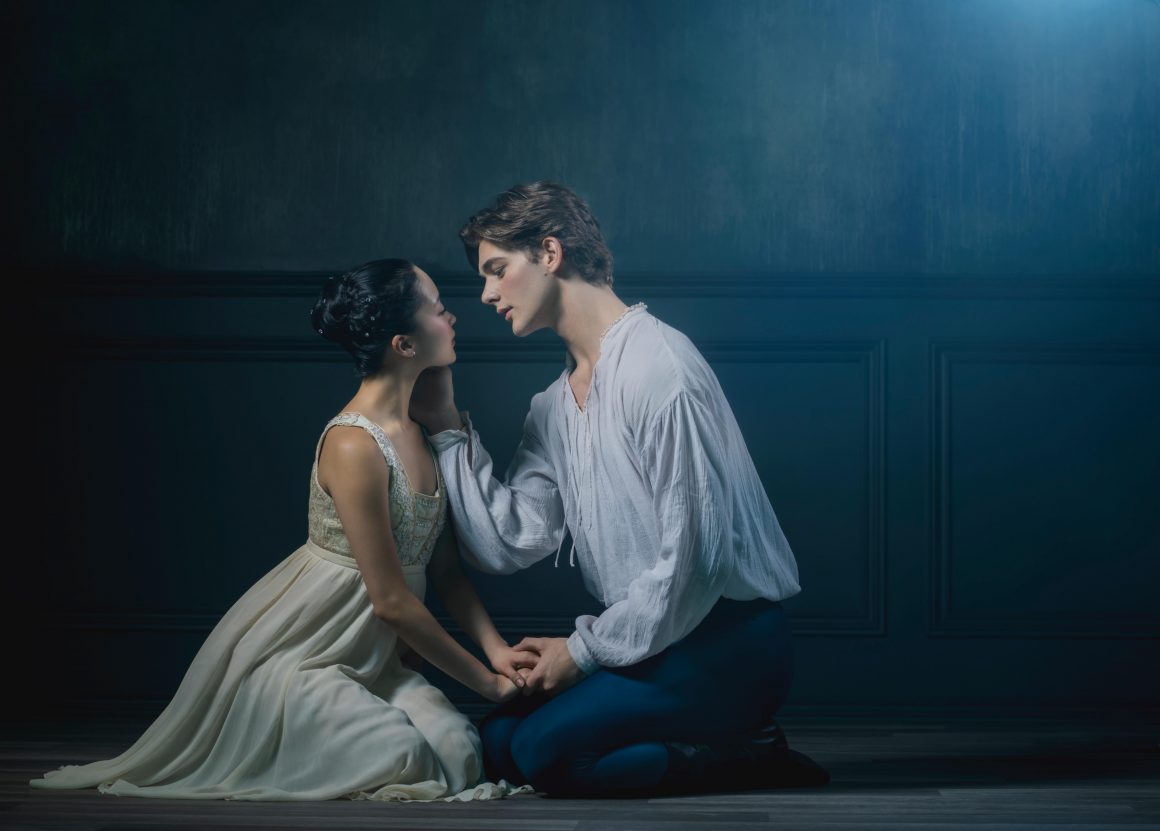
Alberta Ballet presents: Romeo and Juliet
By Laura Beldor, March 23 2026—
From February 12 to 14, 2026, Alberta Ballet staged performances of Romeo and Juliet as part of their 2025/2026 season, “The Season of Legends.”
The Tragedy of Romeo and Juliet is one of Shakespeare’s most well-known and most referenced works, so much so that the names of the star-crossed lovers hold a connotation of love and tragedy within Western culture. Alberta Ballet honoured this legacy through their own take on the iconic story.
Act 1 begins with an introduction to the two noble families at the centre of the story, the Montagues and the Capulets. Lord and Lady Capulet (Kelley McKinlay, Mariko Kondo) lead a procession through Verona’s market square. This display is interrupted when a battle begins between the Montague and Capulet men. The choreography of the sword-fighting sequences within the show is mesmerizing, each thrust of a blade matching the rhythm of Sergei Prokofiev’s score.
Like past productions at the Alberta Ballet, costuming is a conduit of storytelling. In costumes designed by James Ancheson, the dancers are dressed in Italian Renaissance garments; placing this production in the same period as Shakespeare’s original story. Members of the two feuding factions dress mostly monochromatically, with the Capulets wearing crimson and the Montagues wearing blue, including gold details within their clothing to signify each house’s noble status. These opulent costumes not only represent the wealth of both families, but also the staunch divide between them.
Taking part in the fighting are Romeo Montague (Aaron Anker), his cousin Benvolio (Danier), their friend Mercutio (Mirko Melandri) and Tybalt (Yarosslav Khudych), a relation to the Capulets. The battle comes to an abrupt halt when the Prince of Verona (Yi-Min Tsung) arrives and orders the two families to make peace.
In the following scene, Juliet (Luna Sasaki) prepares for her family’s ball with her nurse (Allison Perhach). Sasaki encapsulates the naivete and liveliness of the character in this movement through her spirited movements. Her parents, Lord and Lady Capulet, enter and inform her that she is to be married and that they have already chosen a husband for her, Paris (Rémy Gray).
Later, Romeo, Benvolio and Mercutio sneak into the Capulets’ masked ball in disguise but still incite the suspicion and ire of Tybalt, who recognizes them. It is at the ball where Romeo and Juliet meet for the first time, and the mutual attraction between the two is palpable. Their chemistry was evident not only through the acting by Anker and Sasaki, but also through the lighting and scene direction, which create the illusion that all others fade away when the pair dance together.
After the party, Juliet and Romeo meet again below Juliet’s balcony. They dance together under the light of the moon. The ethereal choreography of their duet establishes the longing and intimacy between the two before they part; the lovers share a passionate kiss.
In the second act, Romeo returns to the bustling market square unable to participate in the merriment of the other townspeople because he is distracted by thoughts of Juliet. Juliet’s nurse delivers a letter to Romeo telling him to meet her at the church. At the church, they are married in secret by the Friar (Kurtis Grimaldi) with Nurse as their witness.
Afterward, Romeo returns to the market, where he is challenged by Tybalt. Romeo refuses to engage, but Mercutio goads Tybalt into a duel. In the fight, Mercutio is mortally injured, and as he dies, he grips the crests of the rival houses, indicating that a tragedy will befall the two families similar to what has befallen him. Romeo, out of grief and rage, picks up his sword and battles Tybalt, fatally wounding the man. This is witnessed by the prince of Verona, who banishes Romeo for this crime.
The final act begins in Juliet’s bedroom after they spend the night together as a married couple. Juliet begs Romeo not to leave, but he insists he must go because of his banishment. After Romeo leaves, Lord and Lady Capulet, who do not know that she is already married, tell her that her wedding to Paris will be the next day. Sasaki skillfully illustrates Juliet’s extreme despair through her dancing and facial expressions during these scenes. In desperation, she goes to the Friar for help. The Friar makes her a potion that will put her in a death-like sleep. After much hesitation, Juliet takes the potion, and her family assumes she is dead.
At her funeral, Romeo appears and kills a grieving Paris. Not knowing that Juliet has taken the potion, he is filled with deep sorrow upon seeing her seemingly lifeless form. Anker portrays Romeo’s grief as hauntingly beautiful, as the manner in which he lifts and dances her limp body is similar to the pair’s earlier duet below the balcony. Consumed with sadness, he drinks poison in hopes of dying with his lover. As he dies, Juliet awakes from her sleep just in time to witness his last breaths. She is immediately engulfed in her own grief and decides to stab herself in the chest, and dies in Romeo’s arms. The members of both families are united through their mourning and come together and end their feud once and for all.
Overall, Alberta Ballet’s production of Romeo and Juliet is a showcase of passion in various forms. The choreography, costuming, lighting, and set design all work together to emphasize the intense emotions of love, hate and sorrow experienced by the various characters.