
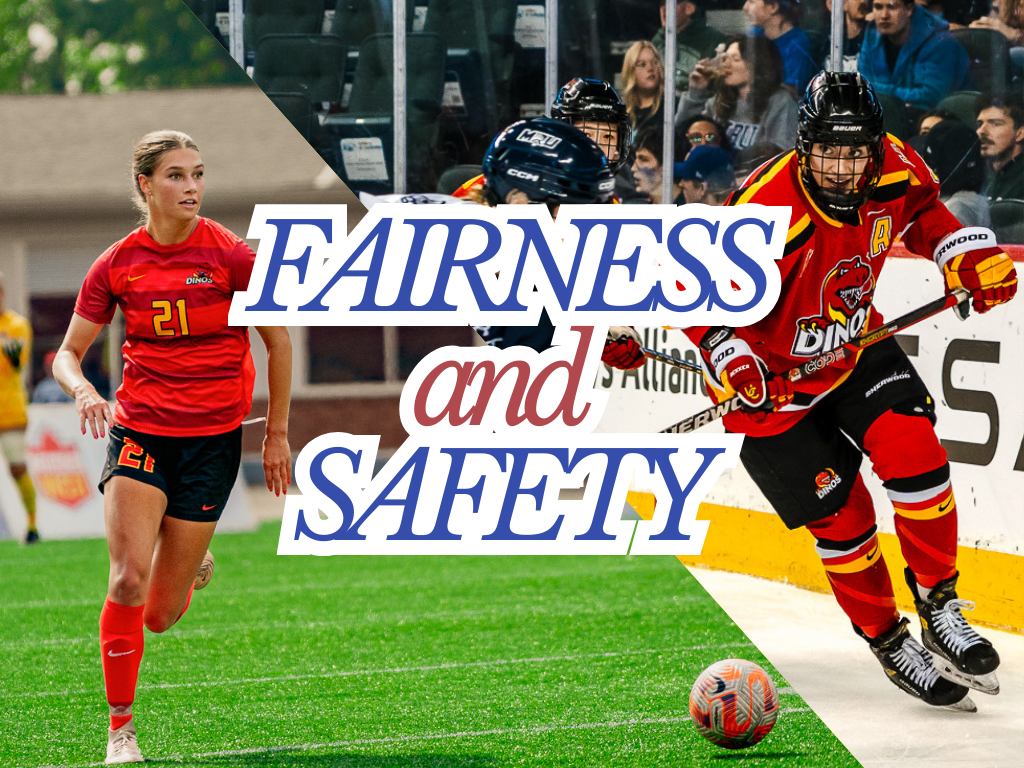
Girls interrupted: the immediate impact of Alberta’s newest legislation
By Leigh Patrick, October 1 2025—
Joining a sports team builds community, fosters teamwork and creates lasting friendships, but Bill 29, Alberta’s Fairness and Safety in Sport Act, which took effect Sept. 1, 2025, threatens to take this experience from girls.
What Bill 29 actually says
The legislation introduces new eligibility rules affecting participation in female-only sports. Girls aged 12 and older must have their guardians confirm that they were assigned female at birth to participate in an all-girls league. If anyone questions an athlete’s eligibility, she must provide a birth certificate or other birth registration documents as evidence.
The complaint-based process means any individual may trigger an eligibility check, creating extra challenges for athletes and their families. Moreover, individual institutions — whether they be schools, universities or sports organizations — must create their own processes for confirming eligibility, an inclusion which raises questions about consistency and fairness.
The result? Trans athletes — who are already the most excluded and vulnerable in sport — and all girls are placed under suspicion. Trans girls are being directly targeted and harmed by the new legislation, and when the government attacks trans girls, there is an attack on all girls and the very idea of gender. The bill risks decreased engagement, undermines inclusion and reinforces a sexist double standard by the absence of any mention of “male” sports leagues.
Discouraging youth engagement
The new legislation states that any “female-only league, class or division” must “consist entirely of individuals whose sex at birth is female.” Since eligibility begins at age 12, it is essential to consider the children, the ones this legislation claims to protect.
At 12, girls are at a vulnerable stage for body image and self-esteem. Studies done by the Journal of Eating Disorders and Durham University’s Nicole Lousie Hason, show that girls as young as six can develop insecurity and mental health concerns in relation to their body image. In a culture focused on policing girls’ bodies, this legislation adds pressure to fit someone else’s definition of what makes a girl. Mandating official confirmation of biological sex for participation may lead girls to feel like their physical selves aren’t meeting societies standards, aren’t feminine enough or that they need outside validation, undermining their self-image and confidence. This forced declaration of bodily information in a public context can heighten anxiety and stress by making girls feel exposed, judged or disbelieved.
Over one million girls in Canada already miss out on sports, with dropout rates spiking in adolescence. “Girls are still saying that sport just doesn’t feel like it’s been designed with their needs and interests in mind, and that they’re confronting barriers that are keeping them from playing sports at all,” Allison Sandmeyer-Graves, CEO of Canadian Women & Sports, said in an article by Radio Canada International.
The legislation is already pushing girls to drop out to avoid the invasive eligibility challenges. Girls are caught between complying with rigid definitions of identity or stepping away from something they love. This risks girls missing out on critical social, emotional and health benefits that sports provide.
For example, for girls living in non-traditional family arrangements — such as foster care, care homes, unstable or unsafe housing — a sports team may serve a greater purpose than simply playing a game: it becomes a source of stability, a chosen family, and a haven for self-expression and safety.
When an adult questions a girl’s identity — when a government puts every young woman under scrutiny — that sense of safety is unravelled. The team is no longer a refuge, but another site of surveillance.
Administrative and financial hurdles
Requiring proof of a girl’s assigned sex at birth introduces financial and administrative hurdles to consider. Birth certificates are often lost, destroyed during moves or buried in years of paperwork, and replacements are time-consuming and expensive.
University athletes face a particular challenge, especially those who were born outside Alberta — navigating the bureaucracy of their birth province or country when they may have other, more important matters to attend to or may be lacking the financial ability to jump through so many hoops. International students at the U SPORTS level face added complications. Many don’t carry their birth certificates, and sending identity documents internationally can be risky and slow. But for all students, retrieving these documents can be a battle, especially without parental support.
These bureaucratic barriers may push families and young women to opt out of sports entirely — not because they don’t care, but because the system has made participation too costly, complicated and invasive.
Why only girls? The sexism behind the policy
No equivalent scrutiny exists for all-male teams. The policing of women’s sports under the guise of fairness is not new — it reflects a historical pattern that society has used to define and control women while hiding behind a facade of safety.
This scrutiny often occurs when women excel. When Caster Semenya won decisively at the 800-meter at the Berlin World Championships, she was criticized and subject to invasive sex testing. Annet Negesa, a middle distance runner, was told she needed to undergo medical intervention to meet the arbitrary standards of femininity. These are not isolated incidents; they are part of a pattern, and Bill 29 continues that pattern.
The legislation is simply another mechanism that legalizes the government’s control over women — both transgender and cisgender — while allowing male athletes to compete without question. It’s a sad and familiar guise: using the supposed safety of women to mask transphobia and misogyny.
If this law were truly about fairness, it would apply to all athletes. If it were about safety, it would protect everyone. Instead, it targets. It isolates. It reinforces the idea that girls’ and women’s bodies are public property to be inspected, judged and regulated.
A clear message is being sent to those who do not align with society’s standards of womanhood and girlhood: that they are to be singled out and excluded. When someone fails to conform, society denies them a place in it. The starting point may be sports, but the impact extends further, serving as a warning to a broader system of control.
Bill 29 claims to protect fairness and safety in sports, but in practice, it is exclusionary, reduces participation and intensifies gender policing. It burdens families and destabilizes teams while reinforcing sexist norms. If we want fairness and equality, we need policies that preserve dignity and identity. If sport is a space of belonging, growth and joy, then this legislation is a direct threat to that promise.
Girls deserve better — all of them.
This article is a part of our Opinions section and does not necessarily reflect the views of the Gauntlet editorial board.