
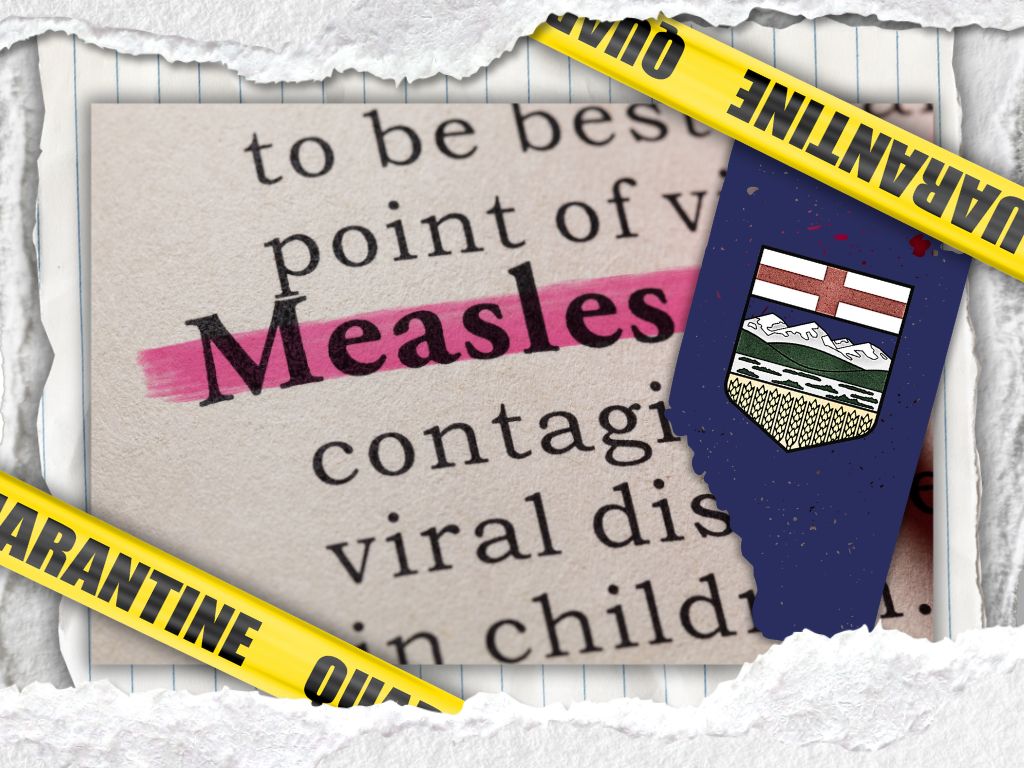
Alberta rolled the dice on “personal choice,” measles won
By Khadija Tembo, January 18 2026—
Forget the idea that Canada “lost” its measles-free status. We didn’t lose it — we eroded it. Slowly and predictably, with Alberta playing a leading role, public health cracks have widened into gaping fault lines.
As of Nov. 8, 2025, the Government of Alberta reported 1,960 confirmed measles cases in the province. Meanwhile, in Ontario — Canada’s most populous province with approximately three times Alberta’s population — the latest official tally as of Nov. 11, 2025, is 2,376 cases (2,061 confirmed, 315 probable). When we adjust for population size, Alberta has approximately 446 cases per million, while Ontario has 158 cases per million. In short, Alberta’s outbreak is significantly worse than Ontario’s.
But let’s step back and consider what we’re dealing with. Measles is no innocuous rash: it’s a highly contagious, viral illness whose symptoms, according to the CDC, often resemble a cold or flu at the beginning. Within a few days, the signature rash appears. But the risk doesn’t end when the rash fades. Complications are serious: about one in five people with measles may be hospitalized, one in 20 children may get pneumonia, one in 1,000 may develop brain swelling (encephalitis), and up to three in 1,000 may die.
In Canada, measles was declared eliminated in 1998, thanks to high immunization coverage and sustained public health campaigns. That status meant the virus was no longer spreading continuously in local communities — only isolated imported cases. However, this changed in 2025. According to the Center for Infectious Disease Research and Policy (CIDRAP), Canada recorded over 5,000 cases this year, triggering the loss of our measles-free designation.
So how did we get here — and why is Alberta such a key part of the story?
For years, Alberta’s government has adopted an informal stance of neutrality on immunization policy. Rather than framing vaccination as a communal duty and a public-health priority, the narrative quietly shifted toward individual decision-making: do your own research, meet your personal risk, weigh your options. The province leaned on the rhetoric of “personal choice,” emphasizing that the vaccine is available and recommended, but essentially leaving the heavy lifting to individuals.
At the same time, routine vaccination coverage in Alberta declined. Pandemic disruptions played a role, as did the broader erosion of public health messaging credibility. But the province’s own communications contributed: consistent encouragement, yes; strong mandates, no. In policy and practice, Alberta’s health messaging often focused on eligibility, access, and individual decision-making more than on collective protection and community responsibility.
This “choice” framing has been politically convenient, but scientifically disastrous. When vaccination is portrayed as a lifestyle preference rather than a crucial public-health measure, people interpret risk through personal filters rather than societal ones, and a knowledge gap is created. In that gap, social media influencers, podcasts, chat groups, peer posts and poorly verified information flourish.
Alberta left a knowledge vacuum — and misinformation rushed in to fill it.
The consequences are now glaring: declining early-childhood immunization rates, outbreaks in places that should have maintained immunity and the national loss of a status Canada earned decades ago.
And this isn’t an abstract crisis. It should matter deeply to you as students. You’re inherently mobile: you commute, you travel between provinces, you take internships, study abroad, share dorms, hit packed lectures and social events… In short: you’re part of the contact web.
When Alberta’s per-capita measles rate is among the highest in the country, your risk doesn’t just stay in Alberta. It follows you if your travel plans unexpectedly require immunization checks, if your dorm issues an exposure alert, or if your placement abroad is delayed because your vaccination record is incomplete. That’s not “maybe” — that’s now. Your choices, and those of the people around you, ripple outward.
The loss of our measles-free status is a wake-up call. For Alberta, for communities and for students travelling into a world that assumes you are protected — not exposed. Because measles isn’t subtle, and neither should we be.
If Alberta wants to stop being the province dragging down Canada’s immunization reputation, it needs a full course correction. Not half-statements. Not soft language. Not politically convenient neutrality. Students deserve clarity. Communities deserve protection. Public health deserves a government willing to speak the truth plainly.
Alberta can keep soft-pedalling its vaccine messaging, but outbreaks don’t negotiate. The longer we avoid decisive action, the louder measles will speak for us — and its lessons are rarely gentle.
This article is a part of our Opinions section and does not necessarily reflect the views of the Gauntlet editorial board.