
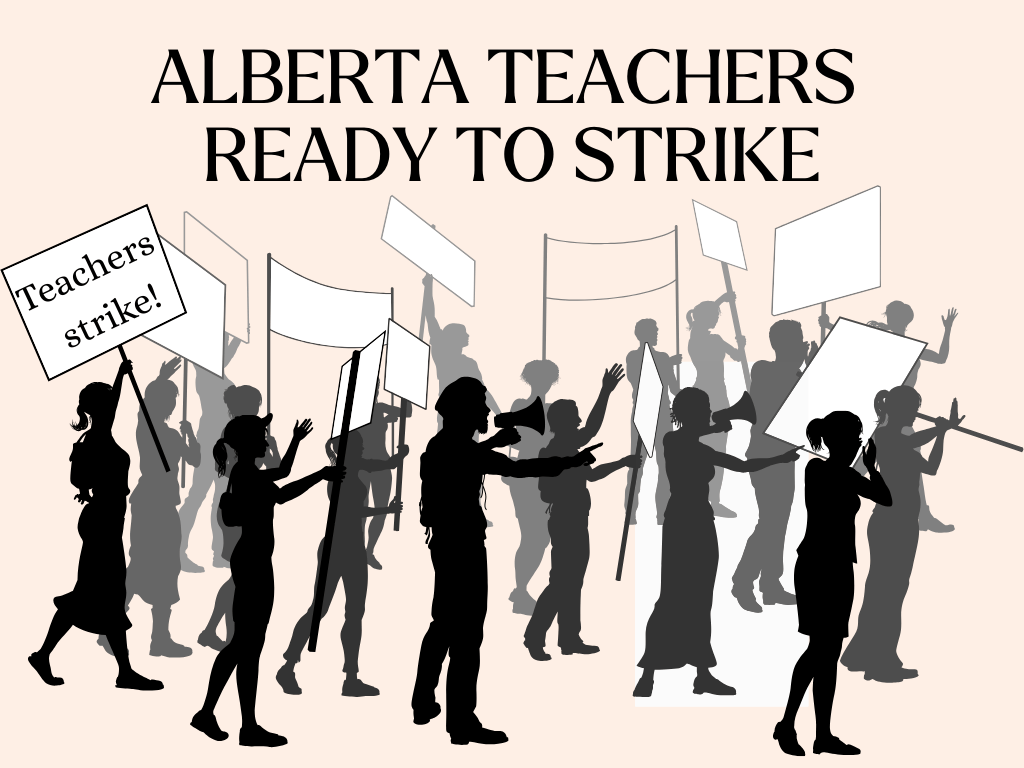
Why are Alberta teachers going on strike?
By Imran Ahmed, October 6 2025—
On June 10, more than 38,000 Alberta teachers cast their ballots in what was a decisive strike authorization vote. Over 99 per cent voted in favour of strike authorization, giving the Alberta Teachers’ Association (ATA) the legal ability to call a strike if negotiations fail, a reality that could only plunge the province’s education system into turmoil.
This result underscores a growing frustration among educators who say they have reached their breaking point. The strike authorization vote followed teachers’ rejection of a mediator’s report in the previous round of central table bargaining between the Teachers’ Employer Bargaining Association (TEBA) and the ATA.
TEBA, which bargains on behalf of Alberta’s 61 school boards while also representing the provincial government by setting financial parameters in negotiations, was contacted for an interview but did not respond in time for publication.
With larger class sizes, weaker supports and wages stagnating against rising inflation, teachers argue the system has been stretched beyond capacity and that past offers, including TEBA’s proposed 12 per cent raise over four years, fail to address their core concerns.
The ATA and TEBA had reached a memorandum of agreement in late September. However, teachers voted 89.5 per cent against the deal, indicating a widespread negative view of the mediator’s offer. Since the deal was widely rejected, tens of thousands of educators went on strike on Oct. 6.
How did Alberta’s once-renowned public education system reach this point of crisis? The looming strike is a function of years of socioeconomic pressures, fiscal choices and shifting policy priorities that have strained not only K-12 classrooms but also the province’s broader education system.
Pay and working conditions
The central issues in most labour disputes are pay and working conditions. The ATA points to stagnant wages that have not kept up with inflation, resulting in weaker purchasing power for teachers now compared to a decade prior. Since 2019, average teacher weekly earnings rose by 14.1 per cent, compared to a 20.8 per cent increase in the consumer price index, the most common measure of rising costs for basic needs, such as food and shelter.
Teachers in Canada are generally paid on a grid based on experience and educational attainment. While interprovincial salary comparisons are often used to assess compensation, they may not capture the realities within each jurisdiction.
In an interview with the Gauntlet, Jean-William Laliberté, an associate professor of economics at the U of C, further explained why those comparisons don’t tell the full story.
“It is difficult because there is no true market wage for teachers. If all jurisdictions underpay teachers, comparisons may be misleading. Compensation includes not just wages but also pensions and workplace quality, which are often overlooked,” Laliberté said.
Even with their limits, inter-provincial salary comparisons remain a tool for assessing compensation. In Alberta’s case, those comparisons raise concerns among teachers and the ATA.
In an interview with the Gauntlet, ATA president Jason Schilling pointed out that while Alberta teachers once held an advantage, other provinces have begun to catch up.
“When you look at other jurisdictions, teachers in Ontario West, for example, have seen larger increases. They started at a lower base salary than Alberta teachers, but their increases have brought them up to or beyond Alberta levels,” Schilling said.
In addition, a higher student-to-teacher ratio has added pressure. Larger classes mean less one-on-one attention and more administrative burden, leaving teachers and support staff working longer hours to make up the gap, which are often unpaid.
“Other provinces embed cost-of-living adjustments into their agreements. BC has class-size caps. Saskatchewan, Ontario and Manitoba have class-complexity language. You have to look at the assignable time and workload as well. Teachers here work more hours with less prep time compared to other provinces,” said Schilling.
Investment in education
Teachers’ frustration over pay and working conditions is rooted in the broader problem of what Schilling described as “chronic underfunding in Alberta, which has existed for about 10 years.”
The United Conservative Party (UCP) has highlighted recent investments as proof of its commitment to schools. In September 2024, Premier Danielle Smith announced an $8.6-billion School Construction Accelerator Program, pledging 90 new schools and 24 modernizations over the next seven years.
However, critics argue that the program is too late, coming years after a period of lagging investment. Nearly 56 per cent of Alberta’s schools are already at least 50 years old, and this share is expected to rise to approximately 70 per cent by 2034. Meanwhile, enrolment has surged faster than the system’s ability to expand, straining classrooms and staff.
Operating budgets face the same strain. While the 2025 budget increased K-12 funding by 4.5 per cent, critics argue that this lags behind the inflationary and enrollment pressures felt by the sector.
“The government funds Alberta classrooms the least in all of Canada. Funding does not keep up with enrolment, inflation or expenditures. We’re not hiring enough teachers for the number of students, so class sizes balloon and students go unfunded,” Schilling stated.
These tensions extend beyond K-12. Since 2019, Alberta’s universities have absorbed operating cuts totalling about 31 per cent. At the U of C alone, the Campus Alberta Grant has been reduced by 23 per cent, worth roughly $135 million before adjusting for inflation.
The provincial government points to a projected $6.5 billion deficit as the key barrier to offering higher wages. This stands in stark contrast to the $8.3 billion surplus recorded just last year. This volatility is a result of how deeply the province’s budget is tied to swings in crude oil prices. For reference, every one-dollar drop in the price of West Texas Intermediate (WTI) crude decreases provincial revenues by about $750 million. Since Budget 2025 was tabled, the government has cut its WTI price forecast by approximately $4 USD.
Added uncertainty from U.S. tariffs and the government’s decision to proceed with a $1.2 billion personal income tax cut has further strained revenues.
Though public education funding has lagged, private institutions have seemingly fared better. In the 2025 Budget, private schools received a 13 per cent increase in funding, outpacing inflation.
“Private schools can cap class sizes, turn away students with needs and charge tuition on top of government funding,” Schilling noted. “For example, Webber Academy spends roughly $23,000 per student per year, while public schools spend just under $12,000. Alberta covers about 70 per cent of private school instructional costs, the highest in Canada. That creates major equity issues, as public money supports private education.”
Impacts on students and families
The consequences of underfunding and labour unrest ripple outward, shaping students’ futures and the stability of families. Teachers warn that strained resources are already undermining social and academic outcomes.
“Since COVID, we’ve been conducting pulse surveys,” said Schilling. “Teachers consistently report more social, emotional and behavioural concerns. Students are struggling more with mental health, and there aren’t enough resources in schools or communities to address it. This directly affects success and can cause disengagement from school.”
Rising class sizes exacerbate these pressures.
“The larger your classes get, and I’ve taught classes of 42, it’s harder to build relationships and provide one-on-one time. In English, for example, it’s difficult to help with writing or projects,” Schilling added.
Class complexity further magnifies the challenge.
“In very heterogeneous classes, it is difficult to adjust the level of instruction appropriately for all students,” Laliberte said. “The composition of the class and the ability to provide specialized services to kids who need them affect learning outcomes.”
These issues are not borne proportionally across all families. Labour disruptions, such as strikes, can widen inequality because wealthier families are better positioned to absorb the disruption.
“Higher-income workers are more likely to work from home and absorb the shock, while lower-income workers often must be physically present at their jobs, which puts their careers in jeopardy,” Laliberte explained.
There is also a rural-urban divide. For example, students in rural Alberta often lack access to specialized staff and must travel to receive support, while those in metro areas struggle to secure services due to large student populations.
At the same time, Laliberte noted that successful bargaining outcomes could strengthen public education in the long run.
“If strikes result in improved wages and conditions, public school quality could improve, reducing inequality. The net effect depends on strike length and whether the gains outweigh temporary losses,” he said.
Weaker support in K-12 affects not only students’ academic performance in the short term but also their ability to transition into higher education or the job market. Laliberte noted that “experiments that randomly assign kids to smaller classes show they perform better on standardized tests that year, and if you track them over time, even 20 years later, it has an impact on earnings.”
Looking ahead
Beyond compensation and budgets, it’s clear that the quality of education for Alberta’s students is at stake.
“The government needs to make real commitments to investing in kids and funding schools properly. Alberta is a wealthy province, yet we fund students the least. That’s a political choice,” Schilling said.
Laliberte suggests that reframing the discussion around compensation, funding and budgets may result in a more productive outcome.
“There is no single correct wage. Governments often argue that higher wages are unaffordable, but if wages are viewed as investments in human capital, budget constraints are less binding,” Laliberte stated. “Good working conditions are also good learning conditions, and these benefits have economic value. Incorporating this perspective would likely support higher wages and better conditions.”
As teachers embark on their first strike since 2002, Alberta’s education system stands at a crossroads. The outcome of this labour dispute will determine not only the immediate working conditions of teachers but also how the province supports Albertan students in the years ahead.